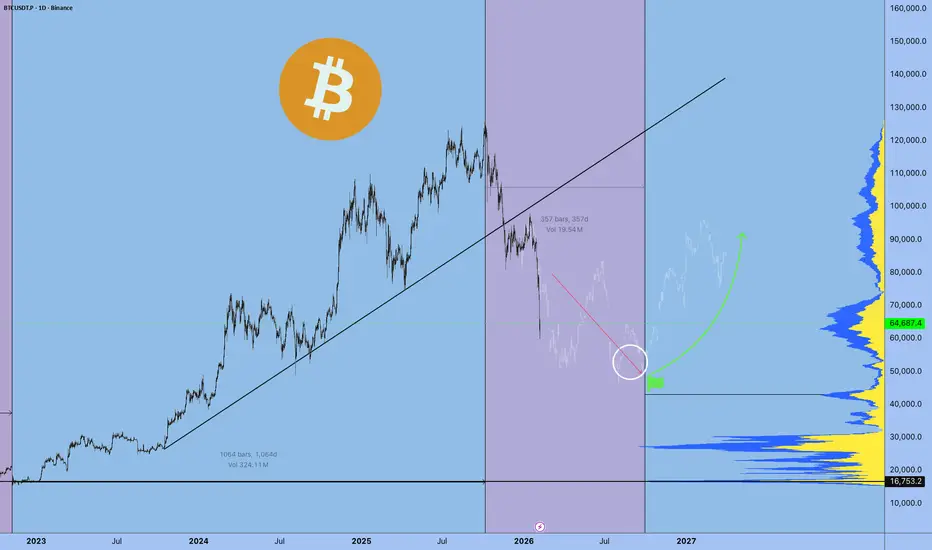
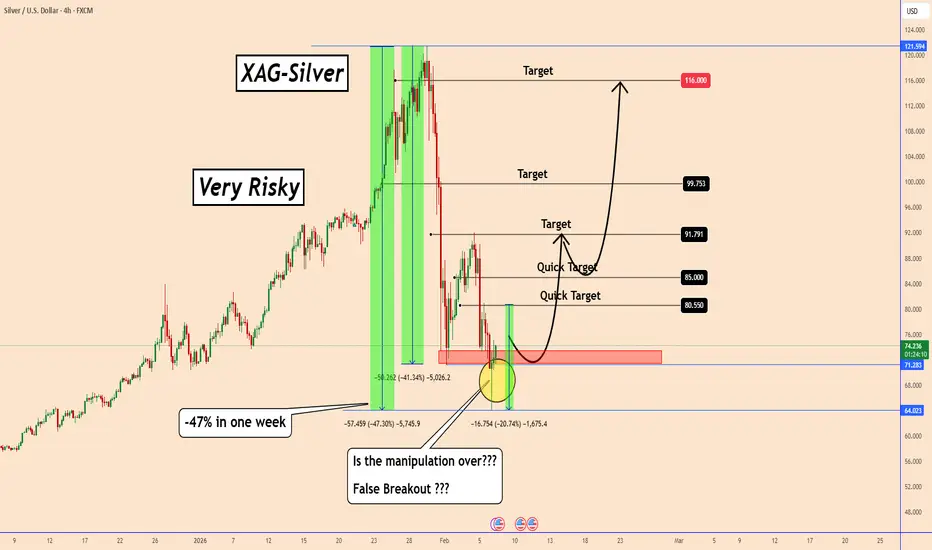
NVDA - Techs Fail and Insiders BailThis chart looks ugly for the bulls. That red trendline has been holding the price up for months, but now it is finally giving way. When a major support level like this cracks, it usually means the uptrend is over and we are heading lower.
But the real red flag is what the leadership is doing.
Insiders are not buying this dip. In fact, they are selling aggressively. The CFO and other top executives have dumped millions of dollars worth of stock recently. If they genuinely believed NVDA was going higher in the long run, they would be holding on to their shares. Instead, they seem to be rushing for the exit.
We have a broken chart and leadership cashing out. That is a dangerous combination you don't want to be buying into.
If the red line is broken the knife will fall.
Community ideas
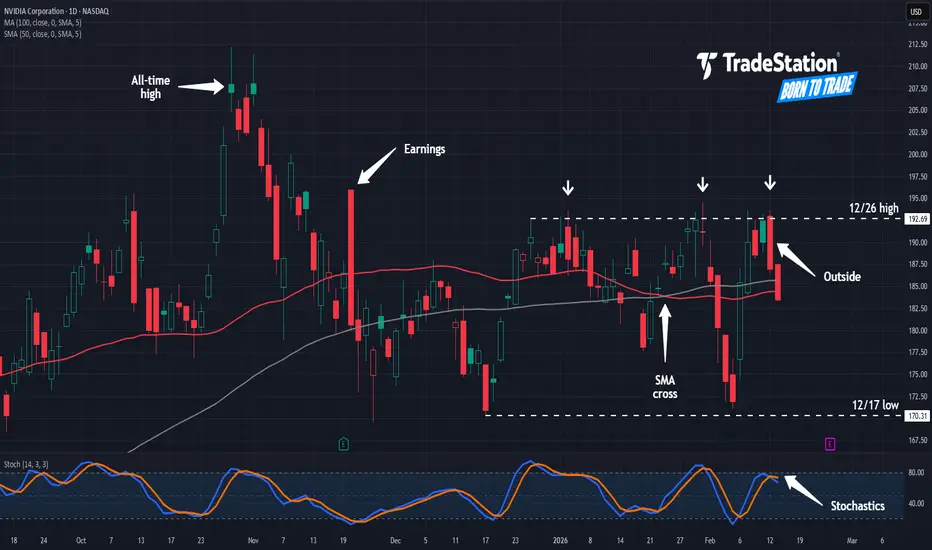
Nvidia May Be RangeboundNvidia has gone nowhere since October, and some traders may think the AI giant is rangebound.
The first pattern on today’s chart is the December 26 high of $192.69. NVDA probed that level in late January and again this month without breaking out. That may suggest that resistance is in place.
Second is the December 17 low of $170.31. The stock fell near that level last month and bounced, which could mean it’s providing support.
Third, NVDA made a higher high yesterday before reversing and closing below the previous session’s low. That bearish outside day is a potential reversal pattern.
Fourth, the 50-day simple moving average (SMA) crossed below the 100-day SMA last month and has stayed there since. Could that signal a weaker long-term trend?
Next, stochastics are dipping from near an overbought condition.
Finally, NVDA is a highly active underlier in the options market. (Its average daily volume of 2.4 million contracts ranks first in the S&P 500, according to TradeStation data.) That could help traders take positions with calls and puts.
TradeStation has, for decades, advanced the trading industry, providing access to stocks, options and futures. If you're born to trade, we could be for you. Learn more here about TradingView’s Broker of the Year!
Past performance, whether actual or indicated by historical tests of strategies, is no guarantee of future performance or success. There is a possibility that you may sustain a loss equal to or greater than your entire investment regardless of which asset class you trade (equities, options or futures); therefore, you should not invest or risk money that you cannot afford to lose. Online trading is not suitable for all investors. View the document titled Characteristics and Risks of Standardized Options at www.TradeStation.com . Before trading any asset class, customers must read the relevant risk disclosure statements on www.TradeStation.com . System access and trade placement and execution may be delayed or fail due to market volatility and volume, quote delays, system and software errors, Internet traffic, outages and other factors.
Securities and futures trading is offered to self-directed customers by TradeStation Securities, Inc., a broker-dealer registered with the Securities and Exchange Commission and a futures commission merchant licensed with the Commodity Futures Trading Commission). TradeStation Securities is a member of the Financial Industry Regulatory Authority, the National Futures Association, and a number of exchanges.
Options trading is not suitable for all investors. Your TradeStation Securities’ account application to trade options will be considered and approved or disapproved based on all relevant factors, including your trading experience. See www.TradeStation.com . Visit www.TradeStation.com for full details on the costs and fees associated with options.
Margin trading involves risks, and it is important that you fully understand those risks before trading on margin. The Margin Disclosure Statement outlines many of those risks, including that you can lose more funds than you deposit in your margin account; your brokerage firm can force the sale of securities in your account; your brokerage firm can sell your securities without contacting you; and you are not entitled to an extension of time on a margin call. Review the Margin Disclosure Statement at www.TradeStation.com .
TradeStation Securities, Inc. and TradeStation Technologies, Inc. are each wholly owned subsidiaries of TradeStation Group, Inc., both operating, and providing products and services, under the TradeStation brand and trademark. When applying for, or purchasing, accounts, subscriptions, products and services, it is important that you know which company you will be dealing with. Visit www.TradeStation.com for further important information explaining what this means.
Nasdaq Crash Incoming: Wave 3 of 3 DownOver in this video, I go through the 5th wave up and identify 2 key things for this top:
1. Wave 5 = Wave 3, since wave 1 is the longest, wave 3 cannot be the shortest wave.
2. 2 Spinning tops marks the peak on 29th and 30th Oct 2025.
The first wave down is a "leading diagonal" because wave 4 overlaps wave 1. The 2nd wave is quite long in terms of duration and forms in an A-B-C. The recent down move is sub-wave 1 of 3 and sub-wave 2 of 3. And we should be expecting a wave 3 of 3 down.
In terms of trading, I recommend being more conservative and setting a higher stop with smaller size but for more aggressive traders, you can place your stop at the recent rebound high but that means you need to be more active in trading.
No matter what, set your size according to your risk management.
Good luck!
Bitcoin flashing traditional accumulation signals (alt season?)TL:DR
Bitcoin is finding a bottom but probably still has some downside. Strong hand are probably accumulating Bitcoin and especially alts.
Introduction
Bitcoin is flashing multiple accumulation signals. But this downtrend has been so gradual and lacking in volatility it barely feels like a bear market to me. Just like the last bull market didn't feel like a bull market to many people use to the traditional volatility of Bitcoin and crypto.
The Top chart
This is pretty simple.
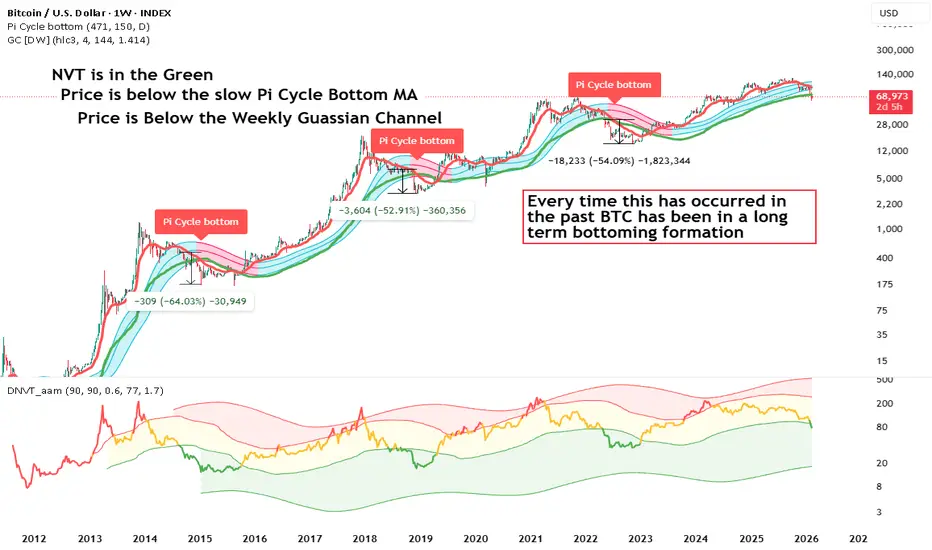
The Weekly NVT is green. Every time its been green before bitcoin has been in a bottoming formation. The NTV is based on the quantity theory of money (QTM) and basically says bitcoin is undervalued at this price level given the number of transactions. You can read up on the QTM here .
Price is below the slow-moving average of the Pi-Cycle Bottom . Pretty simple. The Pi-Cycle bottom was backwards engineered to find bitcoin bottoms and does a good job of at least finding the reversal structure when the fast MA crosses below the slow MA. Of course, in order for this to happen price has to be below both the fast and slow MA, like it is now.
Price is below the weekly Gaussian Channel. Strong hands grab crypto when bitcoin is below the gaussian channel
It is absolutely vital to recognize that both the Pi Cycle bottom hasn't flashed a bottom nor has the gaussian channel turned red. Since both of those have not happened yet its fair to assume we will have both more downside and longer time in the accumulation zone.
BTC Monthly Chart
Pretty simple. Strong hands accumulate when the D- is above the D+. We have fewer examples on this chart than our top chart but the signal is clear. We also easily see the Bollinger band width has reduced and price is close to finding support on the band. In previous bear markets price didn't touch the base of the band for support but it did the last bear market. So we might or might not see bitcoin touch the bottom of the band time around.
Chart experimental overload
The meat of the idea has already been articulated. But I have some other charts I am looking at and this is just for funsies to justify yolo'ing more money into alts.
ETHBTC
The least experimental chart. I have been posting on this since I recognized the double top years ago. Now we have an even bigger double bottom. Quite simply, so long as ETHBTC is in this W pattern and hasn't reached the 1.618 I remain a macro bull on eth and alts. ETHBTC will have times it might consolidate for years. I simply play the chart. It might stall at major fib levels and all time high. I will harvest profit.
bMonthly btcusd/silver
TBH bitcoin doesn't look like it is going to beat silver in the long run. It definitely looks like it is bouncing now. But its at a double top looking neckline to me as it comes out of a bearish rising wedge. I expect to see a bear flag develop at lower time frames.
ETHUSD/Silver
At Descending Triangle 1.618 Target. That's good enough for a bounce or a reversal.
Others.d/btc.d
Want an alt season? then others.d has to go up faster than btc.d And we see it finding support in this channel with a lot of hidden bullish divergence. I expect the price action to reverse at the 0.618 fibline of the channel or at the previous support of the head and shoulders neckline
others.d/silver
I was just experimenting with this chart and saw a pattern. I like patterns. This double top reached its target and now has hidden bullish divergence. And look at that green celery stick of a candle right on the 2.0 fib line.
I am riding others until I see that silver might reverse it (at the double top neckline).
Others/silver
One experimental chart lead to another. Others/silver looks like it might be creating a triangle it could break out of later. Even better if the triangle breaks out to the upside.
Others/Total3
This is another of my main alteason chart. Others is basically everything in the above the top 10 in marketcap. Total3 is everything but bitcoin and Ethereum. Altseason is really about everything above the top 10 going crazy. Crazier than the top 10 coins and definitely crazier than the top 2 coins.
Basically, bitcoin in accumulation and others/total3 painting a triangle suggest altseason is percolating. Waiting for a break out of the blue trendline.
Dxy+btc.d
Alt season generally needs a declining dollar index and dropping bitcoin dominance. So why not smash the two into one chart? Here we go, with a breakdown target. Now I don't have to check btc.d and dxy seperately (but I still do, of course).
Conclusion
I'm in alts. Way up the risk curve from the top 10.
Bitcoin in accumulation and silver pausing and reversing against alts gives permission for this. When BTC.d or BTC+DXY, or DXY or Silver start to show strength then I have to manage that by either rotating into btc or silver.
Sure its a bit complicated but that makes it fun.
Bitcoin: Is the WXYXZ Correction Setting Up Wave C?Bitcoin: Is the WXYXZ Correction Setting Up Wave C?
During the last 5 days BTC declined by nearly 5% from 72250 to 65170
Looks like the B wave has more a corrective movement and is expanding as WXYXZ pattern. If the price manages to move above the previous X near 68300 it will add the chances that our analysis is correct. Until that moment is a bit tricky
Given that the first A wave was impulsive this is adding some extra value that we could be on the C impulsive wave soon as shown in the chart
Key targets:
70800; 72970; 76600; 78970
You may find more details in the chart.
Thank you and good luck! 🍀
❤️ If this analysis helps your trading day, please support it with a like or comment ❤️
Microsoft: a major technical support at $350–$400Should Microsoft stock once again be considered in a DCA zone, after having corrected on the stock market since last November and now being the most expensive (in valuation terms) among the Magnificent 7 stocks?
This is the question I will address in this new analysis on TradingView. Feel free to follow the Swissquote account to be notified of our upcoming analyses on U.S. tech star stocks.
Here are the dominant technical and fundamental factors of our analysis:
• Microsoft shares have corrected by more than 25% since their all-time high reached in 2025, moving against the trend of the other Magnificent 7 stocks
• A major technical support is now close to the current price levels, located between $350 and $400
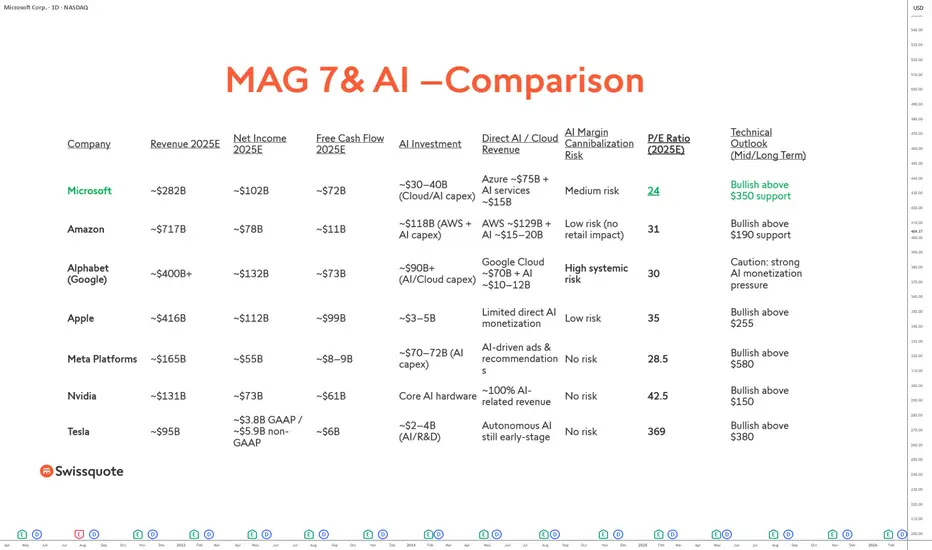
• From a fundamental perspective, Microsoft now has the highest P/E ratio among the Magnificent 7, suggesting potential catch-up opportunities, notably versus Apple and Alphabet (Google)
• Within the software sector, Microsoft has one of the lowest forward P/E ratios
It therefore appears that Microsoft stock is once again becoming an opportunity in the equity market compared to other U.S. tech leaders, provided that the S&P 500 is able to maintain its underlying bullish trend.
The chart below shows weekly Japanese candlesticks for Microsoft stock:
From a technical standpoint, the $350–$400 zone corresponds to a former long-term support that served as the base for several bullish acceleration phases during previous cycles. This area is also reinforced by major Fibonacci retracement levels as well as a high concentration of historical trading volumes. As long as prices remain above this zone, the long-term bullish structure remains intact, despite the significant correction observed since the 2025 peak.
From a fundamental perspective, the recent correction has allowed Microsoft’s valuation to normalize. With a 2025E P/E close to 24 and a forward P/E of around 23.9, the stock now appears cheaper than the majority of major U.S. software companies, while maintaining revenue and cash-flow quality well above the sector average. This is particularly notable given that Microsoft remains one of the best-positioned players in monetizing AI through Azure, cloud services, and the integration of generative AI into its legacy software.
The table below compares market valuations using forward P/E ratios for leading U.S. software companies:
Compared with the other Magnificent 7 stocks, Microsoft currently displays a more reasonable valuation than Nvidia or Tesla, while offering better visibility on cash flows than players such as Amazon. This combination of financial strength, technological leadership, and a valuation that has become attractive again supports the hypothesis of a progressive DCA zone for long-term investors.
In conclusion, as long as the S&P 500 maintains its underlying bullish momentum and the key $350–$400 support holds, Microsoft stock appears to offer a risk/reward profile that has become favorable again, particularly for a time-phased investment strategy.
DISCLAIMER:
This content is intended for individuals who are familiar with financial markets and instruments and is for information purposes only. The presented idea (including market commentary, market data and observations) is not a work product of any research department of Swissquote or its affiliates. This material is intended to highlight market action and does not constitute investment, legal or tax advice. If you are a retail investor or lack experience in trading complex financial products, it is advisable to seek professional advice from licensed advisor before making any financial decisions.
This content is not intended to manipulate the market or encourage any specific financial behavior.
Swissquote makes no representation or warranty as to the quality, completeness, accuracy, comprehensiveness or non-infringement of such content. The views expressed are those of the consultant and are provided for educational purposes only. Any information provided relating to a product or market should not be construed as recommending an investment strategy or transaction. Past performance is not a guarantee of future results.
Swissquote and its employees and representatives shall in no event be held liable for any damages or losses arising directly or indirectly from decisions made on the basis of this content.
The use of any third-party brands or trademarks is for information only and does not imply endorsement by Swissquote, or that the trademark owner has authorised Swissquote to promote its products or services.
Swissquote is the marketing brand for the activities of Swissquote Bank Ltd (Switzerland) regulated by FINMA, Swissquote Capital Markets Limited regulated by CySEC (Cyprus), Swissquote Bank Europe SA (Luxembourg) regulated by the CSSF, Swissquote Ltd (UK) regulated by the FCA, Swissquote Financial Services (Malta) Ltd regulated by the Malta Financial Services Authority, Swissquote MEA Ltd. (UAE) regulated by the Dubai Financial Services Authority, Swissquote Pte Ltd (Singapore) regulated by the Monetary Authority of Singapore, Swissquote Asia Limited (Hong Kong) licensed by the Hong Kong Securities and Futures Commission (SFC) and Swissquote South Africa (Pty) Ltd supervised by the FSCA.
Products and services of Swissquote are only intended for those permitted to receive them under local law.
All investments carry a degree of risk. The risk of loss in trading or holding financial instruments can be substantial. The value of financial instruments, including but not limited to stocks, bonds, cryptocurrencies, and other assets, can fluctuate both upwards and downwards. There is a significant risk of financial loss when buying, selling, holding, staking, or investing in these instruments. SQBE makes no recommendations regarding any specific investment, transaction, or the use of any particular investment strategy.
CFDs are complex instruments and come with a high risk of losing money rapidly due to leverage. The vast majority of retail client accounts suffer capital losses when trading in CFDs. You should consider whether you understand how CFDs work and whether you can afford to take the high risk of losing your money.
Digital Assets are unregulated in most countries and consumer protection rules may not apply. As highly volatile speculative investments, Digital Assets are not suitable for investors without a high-risk tolerance. Make sure you understand each Digital Asset before you trade.
Cryptocurrencies are not considered legal tender in some jurisdictions and are subject to regulatory uncertainties.
The use of Internet-based systems can involve high risks, including, but not limited to, fraud, cyber-attacks, network and communication failures, as well as identity theft and phishing attacks related to crypto-assets.
How to turn $100 into $1,000,000 through trading?
The answer — You can’t..
Yes, theoretically you can imagine a chain of unbelievable coincidences, aggressive risk-taking, and pure luck. But in reality, that path almost always ends with a blown account long before any meaningful growth happens.
However, most people who enter this field genuinely believe they’ll be the exception. They’re convinced it will work out for them. Social media plays a big role in this — the way trading is presented: a glamorous lifestyle, freedom, expensive cars, travel, and supposedly all you have to do is press “buy” or “sell.”
✨ It creates the illusion of simplicity.
But the market isn’t a button. It’s competition.
Chasing massive returns, people start trading low-liquidity, questionable assets. They increase leverage, go all-in on their account, ignore stop losses. Risk management turns into a myth told by some crazy guy on the street, and their mental state starts resembling that same person preaching about discipline. Every trade becomes a casino bet.
🎢 First comes excitement.
😎 Then euphoria from a random win.
😤 Then aggression after a loss.
🎰 And finally — the urge to “win it back.”
And that’s exactly when the account starts melting the fastest.
💡 The truth is, a successful trader isn’t someone who makes 100x in a month.
A successful trader is someone who earns consistently.
Generating 10–14% per month with proper risk management is an extremely strong result. Most professional fund managers don’t even come close to delivering that consistently over time.
💰 With a $300,000 account — that’s a solid income you can live on.
🍦 With $100 — that’s ice cream money. And that’s okay.
📌 Now the important part.
If you want to start trading and you have $300 — great. Set it aside. But treat it not as a “life-changing opportunity,” but as tuition.
A small account should not be a gambling tool.
It should be a discipline-building tool.
It should be a system-testing tool.
It should be a habit-forming tool.
With a deposit like that, you learn to:
• respect risk per trade;
• accept losses calmly;
• avoid increasing size after a loss;
• stay out of the market when bored;
• follow rules even when emotions scream otherwise.
📈 If you can’t trade $300 consistently and with discipline, you won’t trade $30,000 successfully either. Not only profits scale — mistakes scale too.
❗ And if you quit your job with a $300 account to “fully dedicate yourself to trading,” you should probably go back.
Trading doesn’t like pressure.
When you need to pay rent, cover loans, and buy food, you start making decisions out of fear instead of following your system.
⚖️ And fear and the market are a bad combination.
First — stable income outside the market.
Then — stability on a small account.
Then — capital growth.
Enjoy!
Job Growth Takes Off but Traders Stay Put. What’s Happening?Are these jobs in the room with us right now?
📊 A Blockbuster Headline
The delayed January jobs report arrived Wednesday. Nonfarm payrolls ECONOMICS:USNFP showed 130,000 new hires , more than double the 55,000 estimate. On paper, that looked like a strong start to the year.
Wall Street’s reaction, though, was far from a celebration.
The Dow Jones Industrial Average TVC:DJI slipped 0.1%, or about 67 points. The S&P 500 SP:SPX finished flat, while the Nasdaq Composite NASDAQ:IXIC dipped 0.2%. Traders glanced at the headline, then at the fine print, and decided no buying would be done that day.
🔍 The Fine Print That Changed the Mood
Investors sometimes tend to read beyond the headline, and this report was one of those times. Annual revisions from April 2024 to March 2025 removed 862,000 jobs previously counted as real.
That is the largest revision since 2009.
Add to that another twist: November and December job growth was revised lower by a combined 17,000 jobs, effectively turning what looked like modest gains into slight contraction.
The past few months just got rewritten by nearly one million jobs. Jobs that had sparked buying, rallies, and record highs were built on... fake news?
🧮 The Math Behind the Skepticism
On the surface, 130,000 new hires sounds impressive. Dig deeper, and the composition tells a more nuanced story.
Roughly 82,000 of those jobs came from healthcare, and about 50,000 of that total was in ambulatory healthcare services.
Concentrated growth in one sector often signals structural hiring trends rather than broad economic acceleration. If real. But we all know how busy January is when it comes to hiring.
Meanwhile, employers announced 108,435 job cuts in January, the highest level for the month since the 2009 recession and a 118% increase from a year earlier.
One dataset suggests momentum. Another signals strain. Traders, faced with conflicting signals, chose caution.
🏦 Credibility and the Fed Factor
Federal Reserve officials, including Chair Jerome Powell, have already suggested that labor market data may face more revisions in the near future.
If payroll gains can be revised lower by hundreds of thousands over the course of a year, investors question the credibility of the current strength.
📉 Why Stocks Didn’t Celebrate
Let’s assume that the job number is actually real. Normally, strong job growth sparks optimism about consumer spending and corporate earnings.
A hotter labor market can also complicate rate-cut expectations. Strong hiring may delay monetary easing, which equity markets have come to anticipate.
At the same time, large revisions and rising layoff announcements paint a softer picture beneath the surface. The result is a stalemate. Good news feels fragile.
🎢 A Market Caught Between Signals
Financial markets thrive on clarity. The January report offered energy but limited conviction.
Traders are weighing three key questions:
Is hiring genuinely accelerating?
Are revisions signaling deeper weakness?
How will the Federal Reserve interpret this mix?
Until those answers sharpen, market participants may continue to hold their positions rather than extend them. Next up on the economic calendar — inflation data coming Friday.
Off to you : Are you holding, adding, or getting rid of your stock? Are these numbers as real as your unrealized YTD gains? Share your views in the comments!
$TAO Sitting on a Level That Has Never FailedGETTEX:TAO is sitting on a major long-term support level and this isn’t the first time.
If we look at the last three times we touched this support, we bounced strongly.
We may see some drop to form a wick below the support, just as we’ve seen in the last three instances. However, in each case, we eventually held that level and bounced from it.
RSI is near oversold, and the price extended into support.
Let’s see how the price responds from here.
DYOR, NFA
#TAO
BTC: The "Invisible Wall" at $70k (Why We Flush to $59.8k)The retail narrative is that Bitcoin is "consolidating" at $70k. The On-Chain data says Bitcoin is DISTRIBUTING . We just hit an "Invisible Sell Wall" driven by three massive structural failures. This is not a dip to buy; it is a Rational Deleveraging triggered by a $6.3B supply shock that the market cannot absorb.
1. THE ON-CHAIN REALITY (SUPPLY SHOCK) ⛏️
• Miner Capitulation: Miners transferred 90,000 BTC ($6.3B) to exchanges in the last 72 hours.
• Historic Magnitude: This is the largest miner sell-off since 2024, signaling they are selling to survive as margins tighten.
• The Impact: Spot demand cannot absorb $6.3B in selling pressure without a significant repricing event. The "Wall" is real.
2. THE MACRO & STRUCTURE 📉
Bearish Triggers:
• Yield Spike: US 10-Year Treasury Yields spiked to 4.17% . When risk-free rates rise, capital flees crypto.
• Capital Flight: While BTC is down -3%, high-beta alts (BNB, ZEC, SUI) are down -6%+, signaling a "Risk-Off" environment where liquidity exits to USD, not Alts.
• Broken Support: We lost the 200-Week EMA at ~$68,000, a major secular bull/bear line.
The Conflict:
Retail is waiting for "Alt Season" while Institutions are executing a "Flight to Safety." The divergence between the Miner Sell Wall and retail hope creates a trap at $66k.
3. THE TRADE SETUP 🎯
🔴 Scenario A: The Rational Deleveraging
• Trigger: Rejection at $67,500 - $68,000 (Retest of broken 200W EMA support)
• Entry: $67,500 zone (selling into the Miner Wall)
• Target 1: $62,000 (October Support Cluster)
• Target 2: $59,800 (The "Weak Low" Liquidity Sweep)
• Stop: 4H close above $70,500 (Invalidates the Miner Capitulation thesis)
🟢 Scenario B: The Reclaim (Low Probability)
• Trigger: Daily close back above $70,000
• Context: Requires Miners to stop selling and Coinbase Premium to flip positive
• Target: $74,000 range high
MY VERDICT
The "Miner Wall" is too heavy. The market needs to clear the leverage at $59,800 before the bull run can resume. I am positioning SHORT into any relief rally near $67.6k. Confidence: 75% Bearish
Silver Under Pressure – Sellers Are in ControlXAGUSD is currently clearly leaning toward a short-term BEARISH trend, as both recent news and the technical structure fail to support a sustainable bullish move.
From a news perspective , silver is facing pressure from profit-taking after the previous strong rebound , while the U.S. dollar and U.S. Treasury yields are showing signs of stabilization. This has made short-term capital more cautious toward metals like silver , which are highly sensitive to USD fluctuations. When safe-haven demand is not strong enough, rallies in XAGUSD are more likely to be viewed as selling opportunities.
On the H4 timeframe, the bearish structure remains firmly intact . Price is still below the Ichimoku cloud and moving within a descending trend channel, confirming that sellers continue to control the market. Recent rebounds have only produced lower highs, highlighting weak buying pressure and a lack of follow-through.
The 86.0–86.4 zone is acting as a key resistance area , where the descending trendline and the Ichimoku cloud converge. Repeated rejection from this zone would further reinforce the bearish scenario . If XAGUSD fails to break and hold above this resistance, the probability strongly favors a renewed move lower, with an initial target near 70.0, followed by a deeper extension toward 69.9, as highlighted on the chart.
In summary, XAGUSD is currently in a technical rebound within a larger downtrend. The most sensible approach at this stage is to prioritize SELL setups on rallies, patiently waiting for price-action confirmation, rather than attempting to catch a bottom while the dominant trend remains unfavorable for buyers.
S&P 500: Late-Cycle Signals Are BuildingThe S&P 500 is still holding near highs, but under the surface, things are starting to weaken. Both the chart and the economy are sending warning signs that are easy to miss if you only look at price.
Weekly Bearish Divergence
On the weekly chart, price made higher highs, but momentum did not . This is called a bearish divergence and it often shows up near the end of long uptrends.
It doesn’t mean the market crashes immediately but it usually means upside is running out of fuel.
A Fractal From the 2021 Bear Market
The projected move on the chart is based on what happened in 2021–2022:
- momentum faded
- price stayed high for a while
- then the market broke down and turned volatile
The current structure looks similar not identical, but familiar enough to be cautious.
The Economy Is Slowing
While prices are high, the economy is cooling:
- Layoffs in January 2026 were the highest since 2009
- There are now fewer job openings than unemployed people
- Wage growth is slowing
- Home sellers heavily outnumber buyers
- Consumer spending is weakening
These are classic late-cycle signals.
Bonds, Rates, and Pressure
Big foreign holders are selling U.S. bonds, pushing yields even higher. This creates pressure on stocks.
What This Means
When you combine:
- fading momentum on the chart
- a setup similar to past bear markets
- weaker jobs and spending
- stress in housing and bonds
You get a market that looks strong on the surface, but is losing strength underneath.
Conclusion
This doesn’t mean a crash tomorrow. But it does suggest that the S&P 500 may be entering a bear-market phase, not just a normal pullback.
Markets usually warn before they turn and right now, those warnings are getting louder.
EURUSD Buyers in Control After Corrective Move, Eyes on 1.1930Hello traders! Here’s my technical outlook on EURUSD (1H) based on the current chart structure. EURUSD previously traded within a strong bullish environment, supported by a well-defined rising trend line. During this phase, price consistently formed higher highs and higher lows, confirming sustained buyer control and healthy upside momentum. This bullish impulse led to a breakout above the key Buyer Zone around 1.1810, which acted as a strong demand area and structural support. After the impulsive move, price reached the Seller Zone / Resistance Level near 1.1930, where selling pressure stepped in. This resulted in a corrective pullback, with price respecting a descending resistance line, indicating a controlled correction rather than a full trend reversal. Importantly, the pullback found support back at the previous Buyer Zone, which has now been tested multiple times and shows clear acceptance as support. Currently, EURUSD is consolidating inside a tight range above the Buyer Zone, while also respecting the rising trend line from below. This compression between horizontal demand and dynamic support suggests that the market is building energy for the next directional move. The recent breakout attempt from the range indicates early bullish intent, while the structure still favors higher continuation as long as support holds. My primary scenario favors a bullish continuation as long as EURUSD remains above the 1.1810 Buyer Zone and continues to respect the rising trend line. The current consolidation appears to be a corrective pause within a broader bullish structure rather than distribution. A successful hold above support could lead to a gradual push higher, with the 1.1930 Resistance / Seller Zone acting as the first upside target (TP1). A clean breakout and acceptance above this resistance would confirm trend continuation and open the door for further upside expansion. However, a strong rejection from the Seller Zone could trigger another pullback toward demand. A decisive breakdown and acceptance below the Buyer Zone and trend line would invalidate the bullish scenario and signal a deeper corrective phase or potential range expansion to the downside. For now, market structure favors buyers, with demand holding firm and price compressing below resistance — a classic setup for a potential continuation move. Please share this idea with your friends and click Boost 🚀
Paypal Bottom is in ?! Long from herePayPal Holdings (PYPL) is currently trading at approximately $40.42 (as of the latest close, +1.30% on the session), marking a continuation of the multi-year downtrend from its 2021 peak of ~$310–$340.
The chart applies a Fibonacci retracement drawn from the 2021 high (~$310.16) to the post-peak low zone (~$30–$34 area projected or historical).
Price has broken below several key Fib levels in sequence:
0.618 (~$89–$105 zone, previously respected as support)
0.705 / 0.786 (~$51–$67 cluster)
Current price action is testing the deeper 0.886 retracement level near $40, aligning closely with the current close.
A notable 1st Quarter Order Block (1Q OB) is visible in the $45–$50 region (prior consolidation/support area), now acting as overhead resistance following the breakdown.
Buy now, or wait for the trendline confirmation.
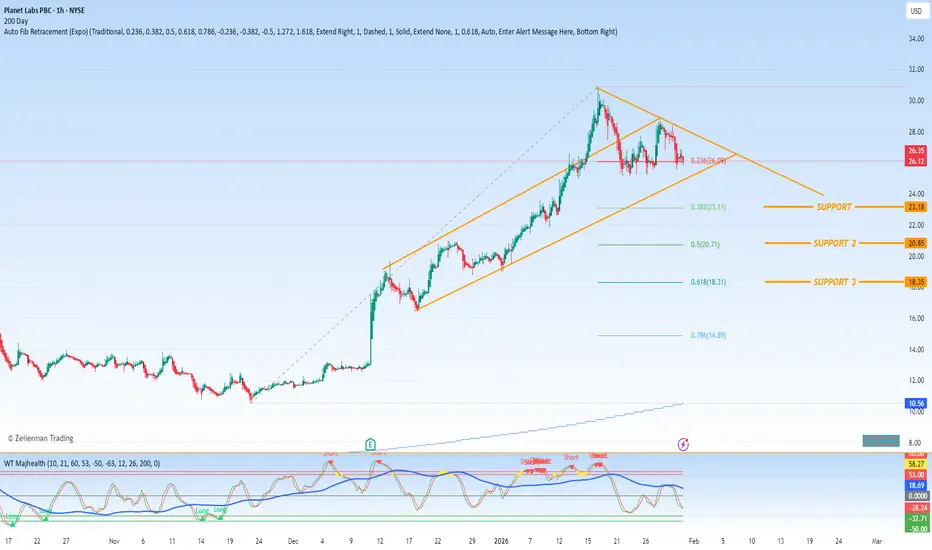
$PL - RACE TO SPACE!This reported merger proposal between SpaceX and xAI, along with the broader industry moves toward orbital AI data centers, represents a bold and high-stakes strategic gambit in the escalating global AI infrastructure race. Here’s a structured analysis of the implications, motivations, and challenges.
1. Strategic Rationale: Why Merge SpaceX and xAI?
Vertical Integration of AI and Infrastructure:
By merging, Musk would create a unified entity that controls both the AI models (via xAI’s Grok) and the physical infrastructure to run them (via SpaceX’s launch and satellite capabilities). This mirrors the vertical integration seen in tech giants like Google (TPU chips + data centers + AI models) but extends it into space.
Funding and Scale:
SpaceX’s potential IPO could raise massive capital. Merging with xAI would channel those funds directly into building orbital data centers, giving xAI a unique competitive edge in computing capacity without relying on third-party cloud providers like AWS or Azure.
Synergies with Starlink:
Starlink’s existing low-Earth orbit (LEO) constellation provides a ready-made network for data relay, latency reduction, and global coverage. AI satellites could integrate into or augment this network, creating an interconnected orbital ecosystem for communication and computation.
2. The Orbital Data Center Vision: Promise and Problems
Potential Advantages:
Nearly Unlimited Solar Power: In orbit, solar panels can generate power continuously (except during brief eclipses), eliminating a major constraint of terrestrial data centers.
Free Cooling: In the vacuum of space, heat can be radiated away passively, avoiding the enormous energy costs of cooling on Earth.
Global Low-Latency Access: Orbital data centers could serve AI applications anywhere on Earth with minimal latency, especially if networked with LEO satellite constellations.
Major Technical and Economic Hurdles:
Radiation Hardening: Space radiation can degrade electronics rapidly. AI chips and memory systems need robust shielding or fault-tolerant designs.
Space Debris and Reliability: Collision risks are real. Redundancy and repair strategies (like robotic maintenance) are unproven at scale.
Launch Costs: Despite SpaceX’s reductions, launching thousands of heavy compute satellites remains prohibitively expensive for now.
Data Transmission Limits: Moving vast datasets to and from orbit requires enormous bandwidth, which could become a bottleneck.
3. Competitive Landscape: Who Else Is Playing?
Blue Origin (Bezos): Also eyeing orbital data centers, leveraging Amazon’s cloud expertise and deep pockets. Bezos has stated a 10–20 year timeline for economic viability.
Starcloud (Nvidia-backed): Already testing AI chips in orbit (Starcloud-1 with an Nvidia H100). Their modular “hypercluster” vision is one of the most concrete near-term plans.
Google (Project Suncatcher): Partnering with Planet Labs for prototype launches around 2027, using custom TPUs.
China’s “Space Cloud” Plan: State-backed effort to deploy AI data centers in space within five years, indicating this is now a geostrategic priority.
The race is no longer just about building better AI models—it’s about securing sovereign control over the next-generation computational infrastructure.
4. Musk’s Timetable: Ambitious or Overoptimistic?
Musk claims space will be “the lowest-cost place to put AI within two years, three at the latest.” Most experts and rivals see this as extremely aggressive.
Deutsche Bank’s forecast (small-scale deployments in 2027–28, scaling in the 2030s) aligns more closely with industry consensus.
The challenge isn’t just launching one satellite with an AI chip (Starcloud already did); it’s deploying hundreds or thousands of them reliably and cost-effectively.
5. Broader Implications
AI Nationalism and Security: If orbital AI infrastructure becomes viable, it could redefine global tech sovereignty. Nations may seek to control their own orbital compute clusters for security and economic advantage.
Environmental Impact: Could reduce terrestrial data centers’ energy and water usage, but might increase launch activity and space debris.
Market Disruption: Companies that master orbital AI infrastructure could undercut terrestrial cloud providers on cost and performance, reshaping the $1T+ cloud computing market.
Conclusion
The reported SpaceX-xAI merger is less about immediate AI model competition and more about positioning for the next frontier of computing itself. Musk is betting that the future of AI scalability lies in space, and he wants to own both the rockets and the AI that runs on them.
While the engineering and economic hurdles are immense, the breadth of investment—from Musk and Bezos to Google and China—suggests this is more than science fiction. It may well become the next great infrastructure battleground of the 2030s.
The key questions remain:
Can radiation-hardened, high-performance computing be reliably deployed at scale in orbit?
Will launch costs fall enough to make this economically viable?
Who will establish the first mover advantage—and will it be decisive?
For now, the race to build the AI backbone in space is officially on.
Bitcoin Back Above $70,000. Here Are Key Levels to Watch NowA trip to $60,000 and back before coffee.
Bitcoin BITSTAMP:BTCUSD spent the end of last week doing what it does best: reminding traders that fire-breathing dragons aren’t in fairytales only.
After a sharp drop to $60,033 on Thursday torched thousands of long positions, the world’s largest cryptocurrency bounced hard. By Friday, it had clawed its way back above $70,000. Still, that dip was the orange coin’s lowest level since October 2024 and roughly 52% below last year’s record of $126,000 .
By Monday morning, Bitcoin looked almost calm. It hovered around $70,700, barely changed on the day. The contrast with last week’s price action felt dramatic. Bitcoin rarely travels in straight lines, and this was another reminder.
🤔 Buy the Dip or Declare It Gone?
As always, opinions split fast. Some traders rushed to declare Bitcoin’s demise (for the 463th time – there’s a website for that ). Others quietly loaded up, calling the move a classic paper-hands shakeout.
Markets, by nature, lean optimistic. The real question is whether optimism has enough fuel to pull Bitcoin out of its recent slump and into a renewed upside phase. The bounce has been impressive, an 18% upswing, but conviction remains fragile.
🌪️ Volatility Is a Feature, Not a Bug
Extreme volatility comes with the territory. Bitcoin’s slide from a $126,000 peak in October arrived despite a crypto-friendly White House and accelerating institutional adoption.
For some investors, that raised uncomfortable questions about Bitcoin’s role during periods of geopolitical stress.
Digital gold? Perhaps. Perfect hedge? That debate remains open.
🧊 The Market Finds Its Feet, Carefully
The broader crypto market has stabilized, though nerves remain close to the surface and Bitcoin still commands the lion’s share, according to the dominance chart . Traders describe the tone as cautious rather than confident. Or every analyst’s favorite expression: cautious optimism.
One level stands out on everyone’s chart. The $60,000 threshold has emerged as the primary near-term support. It marked the floor of last week’s selloff and remains the line bulls prefer not to revisit anytime soon.
On the upside, $75,000 carries symbolic weight. A sustained break above that zone would strengthen the case that the worst of the bear phase has passed and that buyers are regaining control.
📈 Institutions Quietly Step Back In
While price action grabbed headlines, flows told a quieter story. US Bitcoin exchange-traded funds recorded $221 million in inflows on February 6, suggesting that some investors viewed the selloff as an opportunity rather than a warning sign.
Institutional participation tends to move slowly and deliberately. These flows do not guarantee higher prices, but they add some confidence during moments of stress. For a market built on confidence, that matters.
🧮 The Levels That Matter Now
If Bitcoin is serious about $70,000, attention turns to a handful of technical levels that traders are watching closely.
But before that, let’s talk about the 200-week moving average near $58,000, a level Bitcoin respected during the recent dip. Holding above it keeps the longer-term structure intact.
Next sits the $73,000 to $75,000 zone, an area packed with prior support and resistance. Clearing it convincingly would signal momentum shifting back toward the bulls.
Beyond that, the path opens toward $81,000, a level that could act as the next magnet if sentiment continues to improve.
Again, that is if the OG coin manages to reel itself out of the sub-$70,000 area. The bounce from $60,000 reminded traders that sharp selloffs often attract bargain hunters and dip scoopers.
Off to you : So where do you stand right now? Are you holding your Bitcoin, exploring alternatives, or watching from the sidelines? Share how you are navigating this market in the comments.
An At Market & Future Trading Opportunity on GOLDWhat’s Really Going On With Gold?
Gold took a sharp hit to close out last week—but let’s keep things in perspective. This market has been on a massive bullish run, and after a move like that, consolidation isn’t a surprise… it’s normal.
Barring any unexpected geopolitical headlines, the most logical next phase for gold is a pause. And pauses are where some of the best advanced pattern opportunities tend to show up.
A Potential Setup Forming
Dropping down to the 4-hour chart makes things clearer & immediately puts a bat pattern on the radar.
Something Already in Play
If you’re looking for a setup right now, gold has already completed a bearish cypher pattern near the end of last week. Price is currently trading inside the cypher completion zone, which helps explain the recent hesitation and chop.
If you have any questions, comments or want to share your ideas, please do so below!
I wish you guys a great trading week ahead!
Akil
RIOT: Looking for bottoming formationThe overall equity and crypto market crash didn't do any favor to RIOT stock. Despite a lot of good things happening for the company, the short-term headwinds are propelling much of the selling. The rapid selling across the markets has a strong signature of capitulation. Which means, I am now looking for bottoming characteristics to go back in RIOT.
EW count suggests we should have wave 3 of 3 of C complete or near complete. This is usually the strongest part of selling. If we get a consolidation soon for a few days, that will make a strong case for wave 4 and we should see the finishing move with divergences on indicator and sharp reversal soon after. Will look for a turnaround somewhere between $10 and $8. $6.2 cannot break. If that is breached, then RIOT is in a world of hurt.
However, the bottom forms now, I would like to wait to see 5 waves move up. Then on the retrace of that move, the risk to reward would be much better and adding a stop loss should be much clearer. I'd say, time to buy is coming up by the end of February/early March, or maybe sooner.
This Isn’t a Reversal — It’s Only Phase Two. $BTC>65k Thank you for your attention! This is exactly what you've been hearing since September 2025. Next, we'll form the bottom, and reaccumulate until October.
A smart person told me to stop posting publicly. Make everything private, but I continue to publish my thoughts for you.
There are no entry points for positions here; my positions are elsewhere.
I accidentally made a private post yesterday
Right now, it’s still too early to talk about any meaningful reversal. We’re not in a recovery phase - we’re in phase two of the market cycle, and this phase tends to last longer than most expect. The structure is forming exactly as it should: slowly, unevenly, with pockets of stress that haven’t fully played out yet.
Bitcoin is dropping, but for me there’s nothing surprising in this move.
If you’ve been following my posts for a while, you know this scenario was not only possible
— it was highly probable. We’ve already reached the first target zones I highlighted earlier, and the market is now moving toward the deeper structural points that complete this segment of the cycle.
There are still shocks ahead, and the system hasn’t finished recalibrating.
This is not a trend market — this is a regime market. And regime markets demand patience, discipline, and the ability to read liquidity, not headlines.
2026: A Year of Market Regimes
2026 feels like a year defined by regimes, not direction.
This is a market that punishes overconfidence and rewards discipline: managing leverage, staying patient, and understanding liquidity matter more than any narrative.
Liquidity today behaves like a system of pipes. Sometimes the taps look wide open, yet the internal pressure shifts so fast that trends break long before the crowd can explain the move with headlines.
In these phases, Bitcoin behaves not like a “legend”, but like the most liquid proxy for risk:
under stress, it’s the first asset sold because reducing exposure through BTC is the easiest and fastest way.
This leads to a key insight:
Even during superficially “risk-on” news cycles, BTC can underperform when several forces align:
- rising demand for USD (dollar squeeze)
- carry trades unwinding
- capital rotating into leading sectors (metals, indices)
- portfolios cutting risk and closing leverage
Three Structural Scenarios for 2026
I avoid guessing levels; instead, I work with structural patterns. For 2026, I see three core possibilities:
1) Capitulation → Base Formation
A sharp washout, volatility climax, then a broad range and gradual base building.
2) Rallies Within a Larger Downtrend
Strong upside moves that turn into distribution.
The market gives hope — and takes it back on retests.
3) Macro Shock
An event in FX, rates, or liquidity triggers fast deleveraging.
Moves overshoot, correlations spike, and a violent mean reversion follows.
This is why my approach now is very simple:
fewer trades, higher quality.
I’m deliberately reducing the number of positions and focusing only on moments where structure provides a clear edge — because in years like this, capital is preserved not by activity, but by the right pauses.
About the Academy
In parallel, I’m updating my Academy in real time: weekly materials, market structure breakdowns, liquidity updates, USD dynamics, and risk indicators.
The access is open and free — anyone can stay aligned with the current regime without noise.
Current Market Structure
Looking at today’s structure, the market is forming precisely the segment I expected.
The key volume level ahead remains intact, and with high probability, price will break through it. Only after that expansion may we see the formation of the first real leg of the next cycle.
The conservative zones I mentioned earlier remain valid. More negative scenarios exist, yes — but the underlying logic does not change:
Accumulate gradually — on fear, liquidations, and liquidity distortions.
The main zone is very close, and that is where, in my view, the most interesting continuation setup will appear.
Best regards EXCAVO
Silver: From -47% to Bullish Momentum: Silver’s Chaotic WeekSilver: From -47% to Bullish Momentum: Silver’s Chaotic Week
In the first sell-off that silver experienced, the price fell by almost -40%.
After a correction these days, we saw silver move lower overnight creating another structural low.
Just yesterday, silver fell by almost -21%, adding to the biggest drop a correction value of almost -47% in just one week.
Why all this mess, when nothing has changed from a geopolitical perspective.
(Just manipulation by those who created the big bullish wave - My opinion and I don't expect everyone to agree with it)
On the 4-hour chart, the price created a possible false breakout and today silver is resuming the bullish move again as shown in the chart.
However, the bullish move is related to the US-Iran talks. If they don't reach an agreement, silver could probably skyrocket again.
If the US and Iran reach an agreement over the weekend, we could see the markets calm down and perhaps silver could also fall further.
However, this is related to the news in this analysis, but remains bullish and highly manipulated. A bullish wave can happen in the same way as a bearish wave too without any clear idea why. In the same way as it moved down.
You may find more details in the chart.
Thank you and good luck! 🍀
❤️ If this analysis helps your trading day, please support it with a like or comment ❤️
Oracle - The worst drawdown ever!💣Oracle ( NYSE:ORCL ) will ends its bearmarket soon:
🔎Analysis summary:
Over the past five months, Oracle has been correcting more than -60%. And while we can clearly witness a major selloff, Oracle is also approaching a major support area. And if we see bullish confirmation in the near future, Oracle might even create new all time highs.
📝Levels to watch:
$125
SwingTraderPhil
SwingTrading.Simplified. | Investing.Simplified. | #LONGTERMVISION
XAUUSD: Breakdown & Retest Signals Bearish ContinuationHello everyone, here is my breakdown of the current XAUUSD setup.
Market Analysis
XAUUSD previously traded within a well-defined consolidation range, where price moved sideways for an extended period, indicating balance between buyers and sellers and gradual liquidity accumulation. This range eventually resolved to the upside, triggering a clean bullish breakout and a strong impulsive rally. Following the breakout, gold expanded higher aggressively, confirming bullish intent and attracting momentum buyers. However, after reaching the upper highs near the peak of the move, bullish momentum began to fade, and price formed a clear swing top.
Currently, XAUUSD is trading below a key Resistance Zone around 4,950, which previously acted as support but has now flipped into resistance. Several breakouts above this zone failed, suggesting lack of acceptance and strong seller presence. At the same time, price recently broke below the descending triangle support and is attempting a weak pullback toward the broken structure — a classic bearish retest scenario.
My Scenario & Strategy
My primary scenario favors a short continuation, as long as price remains below the descending triangle resistance line and below the 4,950 Resistance Zone. The recent breakout attempts above resistance appear corrective and liquidity-driven rather than signs of a trend reversal. As long as these levels cap price, rallies are viewed as selling opportunities rather than bullish continuation signals. From a structural perspective, the market is transitioning from a bullish expansion phase into a broader corrective or distribution phase. The loss of higher highs and repeated rejections from resistance support the bearish case. The first downside objective lies near the 4,790 Support Zone, which represents a key demand area and a prior breakout level. This zone is expected to act as the first major target where buyers may attempt a reaction. If price reaches the support zone and shows strong rejection or consolidation, a temporary bounce is possible.
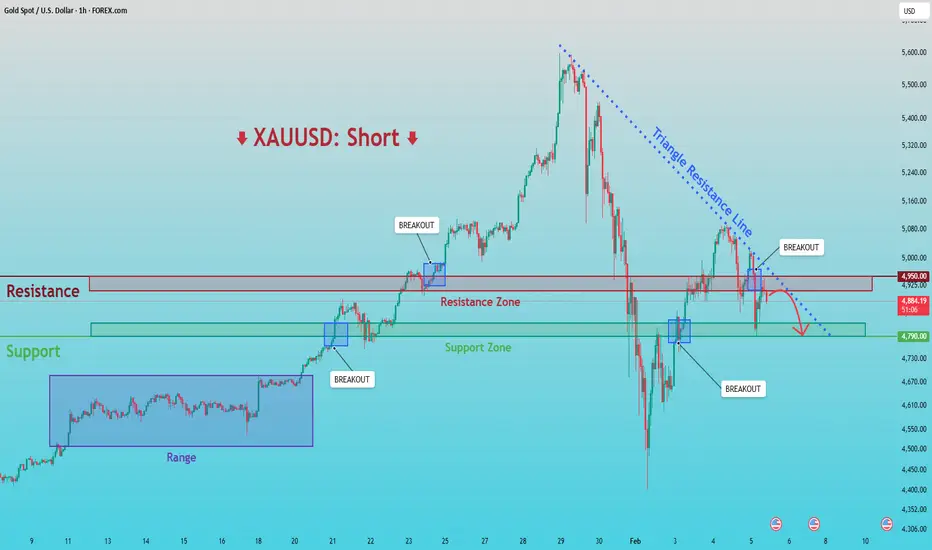
However, a clean breakdown and acceptance below 4,790 would confirm bearish continuation and open the door for a deeper move toward lower demand areas. The short bias remains valid as long as price stays below resistance and the descending structure remains intact. Any strong breakout and acceptance above the triangle resistance and the 4,950 zone would invalidate the short scenario and shift focus back to bullish continuation. Until then, structure favors sellers.
That’s the setup I’m tracking. Thank you for your attention, and always manage your risk.
Is Overtrading Holding You Back? Or Why Less Is MoreMany traders think that activity means productivity. More charts, more clicks, more trades… more monitors?
The day feels productive when something is always happening (ref: the economic calendar ). The sense of participation feels rewarding.
This mindset forms early. And it’s normal — markets stay open across time zones and social feeds reinforce the idea that opportunity lives in constant motion. It becomes easy to believe that frequent action leads to faster learning and better results.
Markets, however, reward decision quality far more than decision quantity.
🤑 The Market Never Sleeps, but Your Edge Does
Markets offer endless movement all across the macro board . Stocks trend, currencies oscillate, crypto trades through weekends, and futures light up overnight. Availability creates temptation. But it also creates a false sense of urgency. And that can lead to overtrading.
Overtrading emerges when availability replaces selectivity. The presence of movement becomes enough reason to participate. Over time, that shift erodes consistency.
📉 How Trade Frequency Dilutes Quality
As trade count increases, standards tend to loosen. Entries happen at random points. Rationales fade and vague ideas begin to qualify. (Why not buy silver OANDA:XAGUSD at $120?)
This process rarely feels reckless. It feels adaptive. The trader remains engaged, yet the edge spreads thinner with each additional position. Performance suffers through gradual dilution rather than sudden failure.
🧮 Why Fewer Trades Improve the Math
Every trade carries friction. Spreads, swaps, slippage, fees, and mental effort accumulate with frequency.
When trades are selective, friction affects fewer outcomes and higher-quality setups offset costs more efficiently.
Many traders improve results by removing their weakest trades rather than adding new tools. Fewer decisions often lead to stronger averages.
🧘 Learning to Sit with Inactivity
Periods without trades feel uncomfortable at first. But with time, perspective shifts and missed trades reveal themselves as avoided losses. Market clarity improves without pressure to act.
After all, you’re not a hedge fund (yet) and you’re not obligated to produce quarterly results for your clients (ok, fine… yet). You don’t need the pressure to act.
Sitting on your hands becomes a skill rather than a weakness. Many traders identify this transition as a turning point in their development.
Here it from the legend himself:
“I began to realize that the big money must necessarily be in the big swing.” - Jesse Livermore.
📊 Cleaner Data, Better Reviews
Fewer trades create clearer feedback because patterns stand out and mistakes become easier to diagnose. What’s more, you can do a much better homework on one or two trades a month than 30-40 trades.
On the flipside, overtrading floods review processes with noise. Selectivity produces cleaner datasets and more actionable insights.
Improvement accelerates when analysis focuses on quality rather than volume.
🎯 Why Less Is More
And here’s why less is more. When you trade less, you do more intentional participation.
It involves waiting for familiar conditions, accepting missed moves, and treating restraint as a form of risk management.
The objective centers on precision rather than presence. The goal here is to last to see another day, because markets will be there tomorrow, offering another chance to pick up a profit.
Again, overtrading often feels productive. Screens stay active and effort remains visible. Markets, however, reward patience, clarity, and selectivity. If the “more is less” concept sounds as distant as “cut losses, let profits run,” worry not — it gets easier.
“It never was my thinking that made the big money for me. It always was my sitting. Got that? My sitting tight!” - Jesse Livermore.
Off to you : How do you approach your trades? Are you the active trader seeking out daily moves in multiple trades or you take a broader view with less time spent in and out of positions?