GOLD Sideways Market: Bulls vs Bears at Key LevelsGold is currently trading inside a descending channel, showing a short-term bearish structure. However, price has recently bounced from the lower boundary, creating a range-bound (sideways) environment between key support and resistance levels.
Right now, gold is not trending cleanly in one direction — instead, it is moving both up and down because the market is in a compression phase. This happens when institutions are collecting liquidity on both sides, taking out buyers above resistance and sellers below support. As a result, we see false breakouts and choppy movement, rather than a strong trend.
Another major reason behind this two-sided movement is fundamental uncertainty. Gold is highly sensitive to USD strength, interest rate expectations, and upcoming economic news. When the market is waiting for important data, price tends to stay indecisive, creating a range until a clear direction is confirmed this current structure suggests the market is preparing for a strong expansion move, but direction will only be confirmed after a breakout.
If price breaks and holds above the 4,780–4,800 resistance zone, we can expect a bullish move as buyers take control and push price higher. On the other hand, if price breaks below the 4,660 support level, it will likely continue bearish toward 4,600, following the overall channel direction.
You may find more details in the chart,
Trade wisely best of luck buddies.
Ps; Support with like and comments for better analysis Thanks for Supporting.
Community ideas
GOLD 4H CHART ROUTE MAP UPDATE & TRADING PLAN FOR THE WEEKHey Everyone,
Please see our 4H chart route map and trading plan for the week ahead.
We are now seeing price play between two weighted levels with a gap above at 4754 and a gap below at 4624. We will need to see ema5 cross and lock on either weighted level to determine the next range.
We will see levels tested side by side until one of the weighted levels break and lock to confirm direction for the next range.
We will keep the above in mind when taking buys from dips. Our updated levels and weighted levels will allow us to track the movement down and then catch bounces up.
We will continue to buy dips using our support levels taking 20 to 40 pips. As stated before each of our level structures give 20 to 40 pip bounces, which is enough for a nice entry and exit. If you back test the levels we shared every week for the past 24 months, you can see how effectively they were used to trade with or against short/mid term swings and trends.
The swing range give bigger bounces then our weighted levels that's the difference between weighted levels and swing ranges.
BULLISH TARGET
4754
EMA5 CROSS AND LOCK ABOVE 4754 WILL OPEN THE FOLLOWING BULLISH TARGET
4884
EMA5 CROSS AND LOCK ABOVE 4884 WILL OPEN THE FOLLOWING BULLISH TARGET
5021
EMA5 CROSS AND LOCK ABOVE 5021 WILL OPEN THE FOLLOWING BULLISH TARGET
5134
EMA5 CROSS AND LOCK ABOVE 5134 WILL OPEN THE FOLLOWING BULLISH TARGET
5250
BEARISH TARGET
4624
EMA5 CROSS AND LOCK BELOW 4624 WILL OPEN THE SWING RANGE
4518
4373
EMA5 CROSS AND LOCK BELOW 4373 WILL OPEN THE SECONDARY SWING RANGE
4221
4074
As always, we will keep you all updated with regular updates throughout the week and how we manage the active ideas and setups. Thank you all for your likes, comments and follows, we really appreciate it!
Mr Gold
GoldViewFX
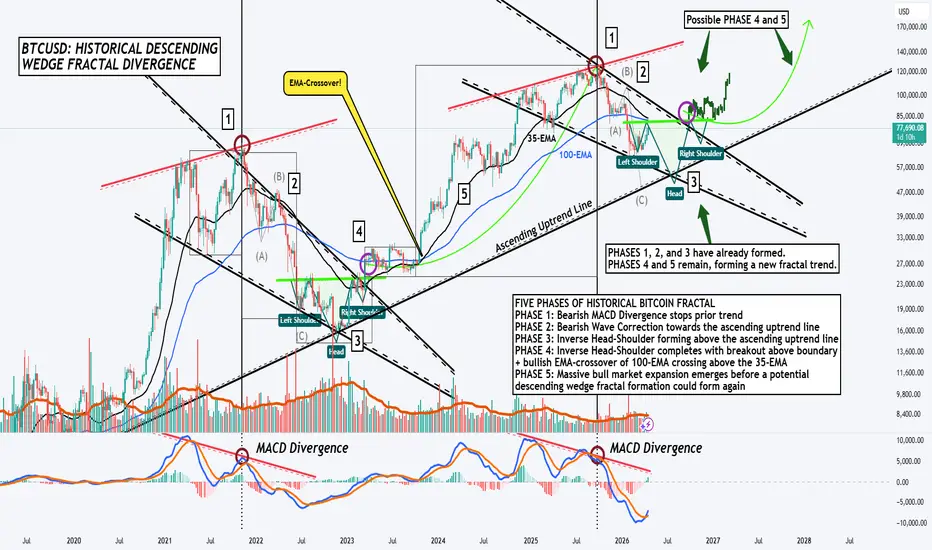
BTCUSD: THIS Historical Fractal Formation Could Complete Again!Hello There,
welcome to my new analysis about BTCUSD on the weekly timeframe. I have spotted a major historical fractal formation that could complete BTCUSD now again. The first phases of the fractal have already been completed. With BTCUSD moving further in this fractal formation, this could be a start of the new cycle repeating.
As when looking at my chart, we can see there that the historical descending wedge fractal consists of exactly five phases. In the first phase, a bearish MACD divergence with the MACD bands closing below the previous high MACD bands signals the MACD divergence. In the second phase, a bearish wave count to the downside dumps right into the ascending uptrend line.
The third phase is an inverse head-and-shoulders formation. The fourth phase is a breakout above the upper boundary of this huge established descending wedge formation and setup above. The fifth phase is the massive bullish expansion towards the upside, also confirmed by a bullish EMA crossover with the 100-EMA in blue crossing above the 35-EMA in black.
Bitcoin has right now exactly completed the first three phases of the fractal since September 2025 again. While there could be short-term bullish pressure that could test the 100-EMA, this is likely to be the point of the major head forming of this inverse head-and-shoulders formation. If this completes as well, there is a huge possibility of BTCUSD continuing with the next phases.
A confirmation breakout above the upper boundary of the gigantic descending wedge formation would confirm phase 4 with the setup to the further cycle repetition in phase 5. The additional EMA crossover would confirm the completion of the historical descending wedge fractal again. In the next times, the further formations of the price action will pave the way for the future cycle.
In this manner, thank you a lot for watching!
The support is highly appreciated.
VP
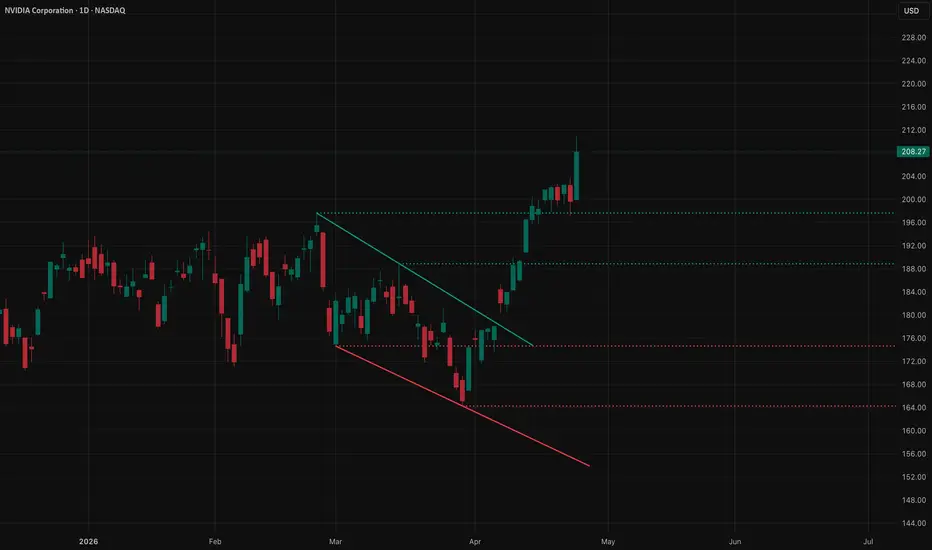
NVDA TA for This Week - April 27NVDA is trading at 208.10, sitting above every meaningful moving average on both the daily and weekly timeframes and pressing into open air above the recent pivot high at 188.88. There is no overhead resistance in the level pack — price has cleared the field. What happens next matters: either this move extends into a genuine continuation leg, or the tape stalls and we start watching the cluster of support structure below for clues on where the next base builds.
This is the kind of price action that looks easy until it isn't.
**1. Context — Bullish Structure, Confirmed**
The weekly structure is clean. NVDA is trading above the weekly 21 SMA at 184.63 and the weekly 50 SMA at 176.00, and the weekly 21 is above the weekly 50 — that's the condition that defines this as a bullish structure. Price is not fighting to reclaim a moving average; it's running above all of them. The daily stack is equally aligned: daily 21 at 187.57, daily 50 at 185.03, and daily 200 at 182.85 are all below current price and stacked in the right order. Every major trend reference is in the bulls' favor.
The weekly 200 SMA at 95.24 and weekly 300 SMA at 69.71 are so far below price they don't factor into near-term trade management. They're context for where the macro floor sits — nothing more right now.
**2. Setup — Extended Rally Into Open Space**
Price has broken through the recent pivot high at 188.88 and is now running without a clearly defined ceiling from this level pack. The move off the recent pivot low at 164.27 has been substantial, and NVDA is now trading roughly 27% above that low. The structure doesn't fit a clean, labeled pattern with conviction, so I'm not going to force one. What I will say is this: price has been trending higher through a stack of support levels that have flipped into a rising floor, and we're now in the upper extension of that move with momentum still pointing up but indicators beginning to flag overextension.
The ATR at 5.45 is the practical measure of daily noise. If you're sizing or placing stops, that's the number doing the work.
**3. Key Resistance — No Overhead Supply, Open Extension**
There are no defined resistance levels above 208.10 in this setup. Price has cleared the recent pivot high at 188.88 and traded through the volume profile's value area high at 191.89. The volume point of control at 188.00 is now below price, as is the VAH at 191.89. There is no pre-defined ceiling to lean against here. That's a double-edged condition — it means there's no resistance to stop a continuation, but it also means there's no price memory above to target precisely. The market is in price discovery above recent structure, and discipline on position sizing matters more in that environment, not less.
**4. Key Support — A Well-Defined Floor Below**
The support structure is layered and relatively close beneath current price.
The first meaningful level is 179.18, which aligns closely with the volume profile's value area low at 177.89 and sits just below the daily 200 SMA at 182.85. A pullback into this zone would be testing a confluence of multiple references — the kind of area where a healthy trend finds footing.
Below that, 174.64 is the next defined support, bracketed by the weekly 50 SMA at 176.00. If price were to reach this area on a pullback, I'd want to see that weekly SMA holding. It's the level the bias rests on: below 176.00 held weekly, the bullish structural argument gets complicated.
The deepest support in play is 164.27, which is also the recent pivot low. That's the swing level that, if broken, changes the character of this move from a healthy trend to something worth reassessing entirely.
The volume POC at 188.00 and VAH at 191.89 are the first zones price would revisit on any near-term pullback — both now acting as short-term support from below.
**5. Targets — Trend Extension**
With no overhead resistance to target precisely, the upside case is open-ended based on this setup. What I can say is that if the trend continues, 191.89 (the VAH) and 188.00 (POC) become the nearest reference points to watch on any dip — reclaiming those quickly on a pullback would signal the trend is intact. Trend extension beyond 208.10 has no defined ceiling here, which means the move lives and dies on momentum and how the indicators behave going forward.
**6. Indicator Confluence — Extended, Watch for Stall**
The daily RSI at 71.5 is overbought. Not catastrophically, but overbought. The weekly RSI at 65.11 is not yet in that territory, which is the mitigating factor — the weekly trend has room to run even while the daily is stretched. Critically, there is no bearish RSI divergence present. That matters. Divergence would be the early warning of trend exhaustion; its absence means the momentum signal is still aligned with the price move.
The daily Stochastic RSI is telling a different story. The K line is at 86.60 and D at 86.57 — they're essentially flat against each other at elevated levels, with the StochRSI itself at 99.36. The weekly StochRSI is at 100, with the K at 93.63 well above the D at 69.60. These are pinned-high readings. They don't predict a rollover, but they do tell you there is very little additional thrust available from momentum alone before a pause or pullback becomes probable. When both the daily and weekly StochRSI are pegged at or near 100, price can still grind higher, but the margin for error on new long entries shrinks.
**7. Levels at a Glance**
Resistance / Upside (above price):
* No defined resistance levels — price is in open extension above 208.10
Support / Downside (below price):
* 191.89 — Volume Area High (VAH), first reference on a pullback
* 188.00 — Volume Point of Control (POC), high-volume support node
* 188.88 — Recent pivot high, now structural reference from below
* 187.57 — Daily 21 SMA, short-term trend reference
* 185.03 — Daily 50 SMA, medium-term trend reference
* 184.63 — Weekly 21 SMA, weekly trend floor
* 182.85 — Daily 200 SMA, long-term daily support
* 179.18 — Defined support, near confluence with VAL and daily 200
* 177.89 — Volume Area Low (VAL), base of volume distribution
* 176.00 — Weekly 50 SMA, structural bias level
* 174.64 — Defined support, inside weekly 50 zone
* 164.27 — Recent pivot low, swing line in the sand
**Final Thoughts**
Bull case: The structural conditions remain intact. Price is above every major moving average, the weekly bias is bullish, and there is no bearish RSI divergence to warn of a reversal. If momentum continues and the daily RSI holds without rolling over sharply, this trend has room to extend into open space above 208.10. Any pullback that holds the 188.00 to 191.89 zone and then reclaims price above the VAH keeps the bull thesis clean.
Bear case: The daily RSI at 71.5 and daily StochRSI pinned near 100 with K and D converging are not bearish signals on their own, but they do flag that the move is stretched. A failure to continue higher, combined with a loss of the POC at 188.00 and then the weekly 50 SMA at 176.00, would start eroding the structural case. Below 176.00, the bullish argument requires reassessment.
**Bottom Line**
NVDA's structure is bullish and the levels confirm it — but price is extended against overbought daily momentum, running in open space with no overhead reference to manage against. Discipline on entries and respect for the support levels below are the job right now.
No hype. No bias. Just levels.
Trade safe. Plan ahead. Win together.
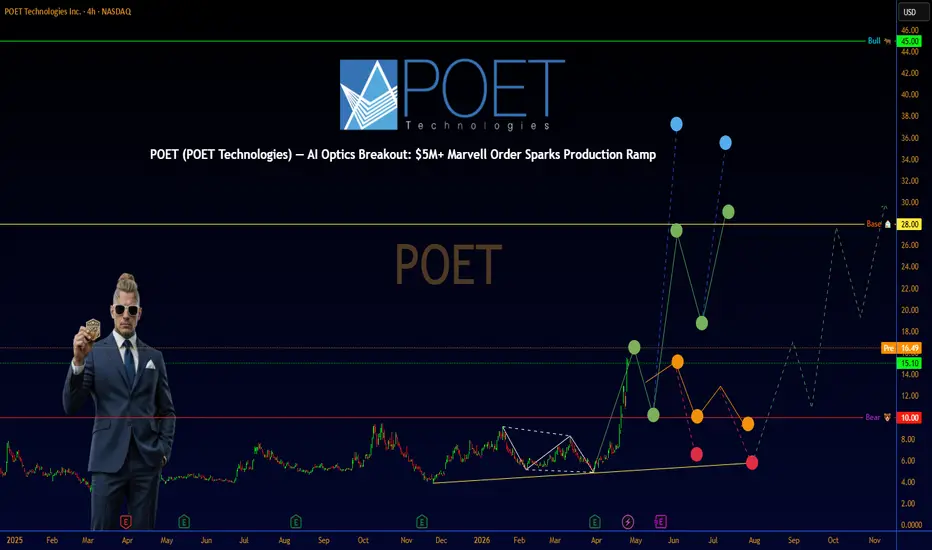
POET (POET Technologies) — AI Optics Breakout: $5M+ Marvell Ordr💡 POET (POET Technologies) — AI Optics Breakout: $5M+ Marvell Order Sparks Production Ramp
**SECTION 1 — Executive Summary** 💼
POET Technologies is at a pivotal commercialization inflection with its Optical Interposer platform solving critical power and bandwidth bottlenecks in AI data centers just as hyperscalers accelerate 800G/1.6T+ optical interconnect deployments. Recent confirmation of production orders exceeding $5 million from Marvell-linked customers plus massive capital raises position the company for its first meaningful revenue ramp in 2026. Overall rating: Buy. 12-month price target: $28 (blended DCF and peer comps methodology incorporating initial optical engine shipments plus TAM capture in AI photonics). The single biggest reason to own this stock right now is POET’s disruptive wafer-scale integration technology delivering lower cost/power optical engines at the exact moment AI infrastructure demand is exploding. The single biggest risk is execution slippage on volume production scaling against well-funded competitors.
**SECTION 2 — Business Overview** 🏢
POET Technologies develops and commercializes advanced photonic integrated circuits using its proprietary Optical Interposer platform that integrates lasers, modulators, detectors, and waveguides onto a single silicon chip for high-speed optical data transmission. Revenue breakdown (latest available): Primarily non-recurring engineering (NRE) and early product revenue from optical engines and light sources with 100 percent tied to AI/data center and telecom applications (no geographic split publicly detailed yet). Business model generates revenue through design wins, NRE fees, and high-margin optical engine/module sales with future recurring potential via licensing and volume shipments to hyperscalers and module makers. Competitive moat comes from patented passive alignment and wafer-scale semiconductor manufacturing that eliminates costly active alignment steps used by traditional photonics players delivering superior cost, power efficiency, and scalability for 800G/1.6T+ AI interconnects.
**SECTION 3 — Financial Deep Dive** 📈
Key metrics (most recent publicly available as of Q4 2025 ended Dec 31 2025; source: company filings Apr 1 2026):
Revenue: $341k (Q4 2025) vs $29k (Q4 2024); TTM ~$1.07M.
Net income: -$42.7M (Q4 2025).
EPS: -$0.32 (Q4 2025, non-GAAP context similar).
Gross margins: Not yet meaningful at commercial scale.
Free cash flow: Negative reflecting R&D and ramp investments.
YoY growth rates: Revenue +1,075 percent (Q4) but from tiny base; net loss improvement on per-share basis.
Balance sheet health: Cash and equivalents ~$430M post-2025/early-2026 financings; low debt; strong liquidity.
Cash flow quality: Operating cash flow negative but aligned with pre-revenue ramp phase (no red flags).
Capital allocation: Heavy focus on R&D, manufacturing partnerships, and production scale-up with recent equity raises funding AI optics acceleration.
**SECTION 4 — Growth Analysis** 🚀
Total addressable market (TAM): Global optical transceiver market projected to reach $27.6B by 2030 (CAGR 16.8 percent 2026-2030 per industry reports); AI-specific segment within silicon photonics/optical engines exceeding $20B+ opportunity by late 2020s. Current market share: Nascent but first production orders signal entry into high-growth AI segment. Key growth drivers for next 3-5 years: Initial shipments of POET Infinity optical engines (800G/1.6T), partnerships with module makers (Lessengers, LITEON), and hyperscaler adoption for AI clusters. Management guidance points to 2026 as inflection with 30k+ engine shipments targeted; analyst consensus more cautious near-term but aligned on long-term optics boom. Growth primarily organic via proprietary platform rather than acquisition-dependent.
**SECTION 5 — Valuation** 📊
DCF analysis: Base case assumes revenue ramp to hundreds of millions by 2028-2030 on optical engine adoption, 40 percent+ gross margins at scale, WACC 12 percent (reflecting early-stage risk), terminal growth 4 percent . Implied value supports $28 target. Comparable company analysis (peers as of April 2026): Broadcom, Marvell, Coherent (optics proxies) trade at 20-40x forward sales on AI growth; early-stage photonics names at premium to revenue. Historical valuation range (limited): Pre-commercial volatility with recent surge. Bull target $45 (accelerated 1.6T+ wins); Base $28; Bear $10 (delayed shipments). Current price ~$15 offers ~87 percent upside to base target.
**SECTION 6 — Risk Analysis** ⚠️
1. Production execution and yield ramp delays (high probability/impact): Triggered by manufacturing scale challenges; watch quarterly shipment updates and partner confirmations.
2. Intense competition from established photonics players (medium-high): Broadcom, Intel, Ayar Labs; monitor design win announcements.
3. Dilution from additional capital raises (medium): Though cash is now strong; track balance sheet updates.
4. Macro/AI capex slowdown (medium): Hyperscaler spend cuts; watch big-tech guidance.
5. Regulatory/PFIC tax or listing risks (low-medium): Recent U.S. redomicile plans mitigate; monitor shareholder vote.
Short interest elevated but declining post-rally per recent data. Insider activity shows confidence via retained holdings. No major accounting quality flags.
**SECTION 7 — Catalyst Calendar** 📅
Next earnings date: Mid-May 2026 (Q1 2026 results with likely production update). Upcoming events: First optical engine shipments targeted Q3 2026; potential additional design wins from Foxconn/Luxshare. Macro events: AI infrastructure capex announcements from NVIDIA/Meta/Google. 12-month timeline: Q2 earnings August, volume production milestones late 2026, potential U.S. listing progress.
Global optical transceiver market exploding on AI demand underpins massive TAM.
AI-specific optical engine packaging trends show clear shift toward co-packaged solutions where POET competes.
**SECTION 8 — Technical Analysis** 📈
Primary Chart: Daily timeframe, 1-year view shows explosive breakout in April 2026 from multi-month base around $5-7 to new 11-year highs near $15+ with massive volume. Price action well above both 50-day and 200-day moving averages confirming strong uptrend. RSI (14) elevated but not extreme (~70+ on surge days) with room before overbought; MACD bullish crossover with expanding histogram. Major support zone $10-12 (prior breakout), resistance $18-20. Visible chart patterns: Clear higher highs/lows since March lows plus volume climax on news. Technical implication: Bullish continuation into May earnings if momentum holds with potential for further extension on positive updates.
**SECTION 9 — The Verdict** 🏆
Bull case ($45 target, 35 percent probability): Multiple design wins and 2026 shipments exceed expectations driving re-rating to AI infrastructure leader.
Base case ($28 target, 45 percent probability): Steady order execution and cash burn management deliver first profitable trajectory.
Bear case ($10 target, 20 percent probability): Ramp delays or competitive losses lead to dilution and sentiment reset.
Expected value calculation: Probability-weighted price target = $28.50. Final recommendation: Buy with High conviction. The 30-second elevator pitch: POET is the rare early-stage photonics pure-play with proven tech, massive cash, and first commercial orders exactly as AI data centers demand cheaper/faster optical engines — positioning it for explosive growth in a $20B+ TAM.
**Sources**
POET Technologies Investor Relations (poet-technologies.com) Q4 2025 results and MD&A Apr 1 2026; Yahoo Finance/Seeking Alpha financial data and news Apr 2026; company press releases on Marvell/Celestial AI orders Apr 2026; industry reports on optical transceiver market (Business Research Company, LightCounting) 2026 forecasts; MarketBeat/TipRanks analyst commentary Apr 2026.
What are your thoughts on POET? Drop them below 👇
#POET #AIOptics #SiliconPhotonics #OpticalInterposer #DataCenterAI #MarvellOrder #PhotonicsStock #800G #1.6T #AIBoom
TradeCityPro | Bitcoin Daily Analysis #284👋 Welcome to TradeCityPro!
Let’s move on to Bitcoin analysis, today the market could finally start a move.
🔥 Since we’re at the end of the weekly candle, Bitcoin’s volume is still very low and price is continuing to range in the same area as yesterday.
🔔 Yesterday, price faked the 77,369 level once. The reason it couldn’t stabilize below this area is the lack of volume — neither buyers nor sellers currently have enough strength in the market.
📊 If market volume was like previous days, after this fake breakdown of 77,369, we should have seen bullish momentum entering the market and the start of an upward move. But right now, even with the fake move, volume is still too low. That’s why I prefer to wait and not open any positions until volume returns.
✨ There’s a good chance that volume will come back during the New York session today or at the start of the new weekly candle. In that case, with a break of the channel and 77,369, we can consider a risky short position. If the market turns bearish, this will be the only short trigger.
✔️ For a long position, if buying volume increases as price moves toward 79,285, we can enter on a break above 79,285.
❌ Disclaimer ❌
Trading futures is highly risky and dangerous. If you're not an expert, these triggers may not be suitable for you. You should first learn risk and capital management. You can also use the educational content from this channel.
Finally, these triggers reflect my personal opinions on price action, and the market may move completely against this analysis. So, do your own research before opening any position.
Why Trading Less Is the Real EdgeMost traders enter the market with a very common belief:
👉 If you want consistent profits, you have to trade every day.
It sounds logical. But in reality, it’s completely the opposite.
After years of trading, I’ve realized one simple truth:
Great traders don’t make money because they trade more — they make money because they trade at the right time.
1. The market doesn’t pay you daily
The market doesn’t care how much you need to make today.
It doesn’t “pay a salary” like a normal job.
There are days when:
● Clear trend → opportunities appear
● Clean structure → easy to execute
But there are also days when:
● Sideways, noisy, no direction
● Price sweeps up and down → destroys every setup
👉 If you force yourself to trade every day, you’re also forcing yourself to trade on days where you have no edge .
And that’s exactly when your account starts to bleed.
2. Great traders don’t look for trades — they wait for conditions
Beginners:
● Open the chart → look for reasons to enter
● Fear of missing out (FOMO) → trade everything they see
Experienced traders:
● Define conditions in advance (structure, key zones, context)
● No setup → do nothing
👉 The difference isn’t in the strategy…
👉 It’s in the ability to not act when it’s not necessary
This is difficult — but it’s the real edge.
3. Fewer trades = fewer mistakes
Every trade you take carries risk.
Trading more does not mean earning more.
It usually means:
● More decisions
● More mistakes
● And more emotional pressure
Great traders understand:
👉 They don’t need more trades — they need the right trades
A week may only require 2–3 high-quality setups…
but that’s enough to generate consistent profits.
4. The market rewards selectivity, not activity
This is something many traders don’t want to accept.
You can:
● Sit in front of charts 10 hours a day
● Analyze constantly
● Enter trades continuously
But without a clear edge…
👉 it’s just activity , not productivity
Professional traders don’t try to “outwork the market”
They simply wait for the right moment when the market gives them an opportunity
5. Not trading is also a decision
This is the most important mindset shift.
Most traders think:
👉 Not taking a trade = missing an opportunity
But in reality:
👉 Not trading without a valid setup = protecting your capital
And in trading:
Capital preservation always comes before profit.
USDJPY 30Min Engaged ( Bullish & Bearish Reversal Detected )HANZO MARKET LIQUIDITY REPORT
USDJPY
Timeframe: 30min (Volume Basis)
Scale: Higher Timeframe Context / Deep Volume analysis
━━━━━━━━━━━━━━━━━━━━━━
Market Observation
This analysis is focusing on structural behavior, liquidity zones, Volume analysis
and key areas of interest within the current range.
━━━━━━━━━━━━━━━━━━━━━━
Market Bias
Full liquidity Map
━━━━━━━━━━━━━━━━━━━━━━
🔥Bullish Reversal
Key Volume Zone : 159.020
🔥Bearish Reversal
Key Volume Zone :159.980
━━━━━━━━━━━━━━━━━━━━━━
5 reasons / For Bullish Reversal
Liquidity pool: 159.00 is a round-number magnet where sell-side stops commonly sit (sellside liquidity).
Engine confluence: Hanzo engine shows 1H liquidity-hunt + 4H reversal, consistent with a sweep lower then bounce.
Discount entry logic: Buying after a dip into the lower edge is a discount approach versus buying mid-range at 159.16.
Front-run buffer: 159.02 slightly front-runs 159.00 to reduce missed fills during fast taps.
Clear mean-reversion target: TP 159.70 aims back into the range toward prior dealing area, not an extended breakout.
━━━━━━━━━━━━━━━━━━━━━━
5 reasons / For Bearish Reversal
Liquidity pool: 160.00 is a major round-number magnet where buy-side stops commonly sit (buyside liquidity).
Engine confluence: With 1D liquidity-hunt and 4H reversal, a push into 160.00 can be a stop-run before rotation lower.
Premium entry logic: Selling near the upper edge is a premium entry versus selling mid-range.
Front-run buffer: 159.98 slightly front-runs 160.00 to improve activation probability.
━━━━━━━━━━━━━━━━━━━━━━
Structure Factors:
• Higher timeframe Volume reaction level
• High-volume / Hidden
• Range Defend structure
• Volume Stacking
• Quarter Volume
• Fibo Defend Volume
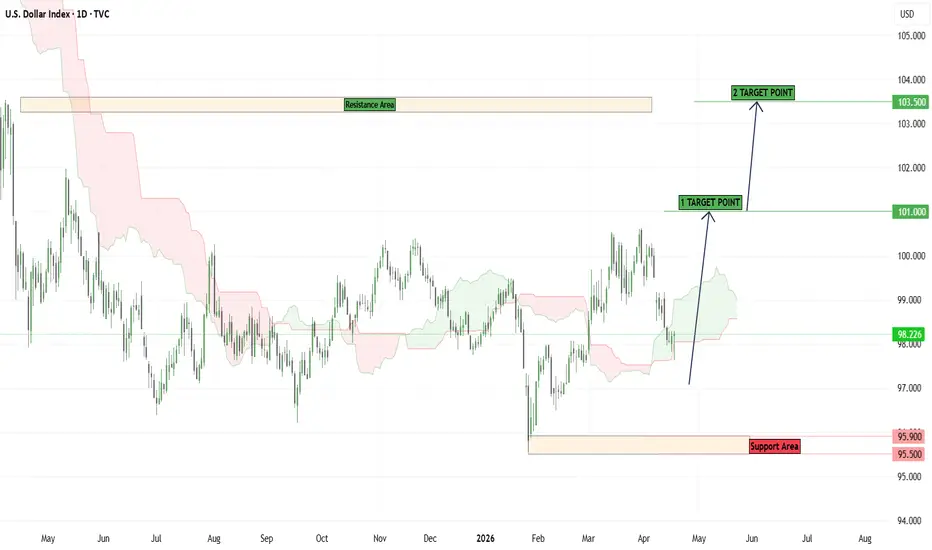
DXY – Market Bullish AnalysisDXY – Market Structure Analysis
Following a prolonged consolidation phase, the Dollar Index (DXY) established a strong base near the support region, indicating accumulation. Price recently showed a bullish reaction from this demand zone, suggesting a potential shift in short-term sentiment as buyers step back into the market.
Currently, price is attempting to build momentum after bouncing from support and is moving toward higher levels within the range. Holding above the current structure would signal strengthening bullish intent and open the path for a continuation toward key resistance zones.
📊 Key Trading Scenarios
✅ Bullish Scenario 🚀
* Price sustains above the 97.00 – 96.50 support region
* Continued higher low formation confirms recovery structure
🎯 Target 1: 101.00
🎯 Target 2: 103.50
❌ Bearish Scenario ⚠️
* A breakdown below 95.50 may invalidate the bullish outlook
🎯 Downside Target 1: 95.00
🎯 Downside Target 2: 94.00
📍 Critical Levels to Monitor
🔴 Immediate Resistance: 101.00
🔴 Major Resistance: 103.50 (Resistance Area)
🟢 Key Support Zone: 97.00 – 95.50
⚠️ Trading Insight
Price is currently reacting from a well-defined support zone and showing early signs of bullish recovery. Sustaining above this region would support further upside toward resistance, while rejection or breakdown could lead to renewed downside pressure.
Note:
This analysis is based on current market structure and price action. Market conditions may evolve—always use proper risk management.
A short-time LONG idea on BTC and ETH. Intraday SetupBTC has just broken out of a multi-day range, clearing the weekly range liquidity.
The price was rejected just above the weekly range, and now a retest of that level is forming.
This is an intraday setup for a quick 1:5 risk-to-reward LONG on the mentioned retest currently forming.
A close above 77,847 without tagging the entry invalidates this setup.
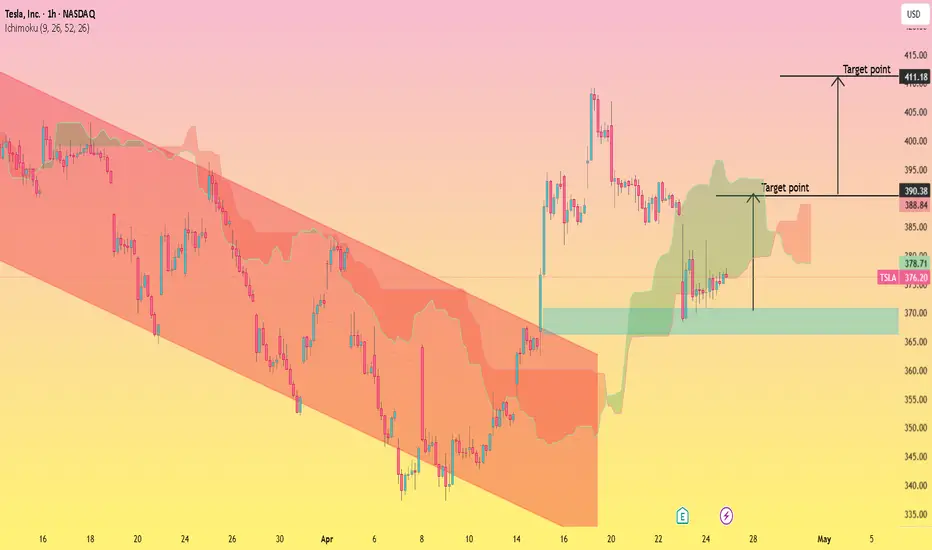
Tesla Breakout After Downtrend – Bullish TargetsThis chart of Tesla, Inc. (TSLA) shows a clear shift from a strong downtrend into a bullish recovery. Initially, the price was moving inside a descending channel (red zone), indicating consistent selling pressure. However, the price eventually broke out of this channel with a sharp upward move, signaling a potential trend reversal.
After the breakout, the price formed a consolidation range around the green support zone (near 370–372), showing stability and accumulation. The presence of the cloud (likely an Ichimoku indicator) suggests the market is trying to build bullish momentum above support.
Targets:
First Target: Around 390–395 (short-term resistance area marked on chart)
Second Target: Around 410–412 (major resistance / target point shown above)
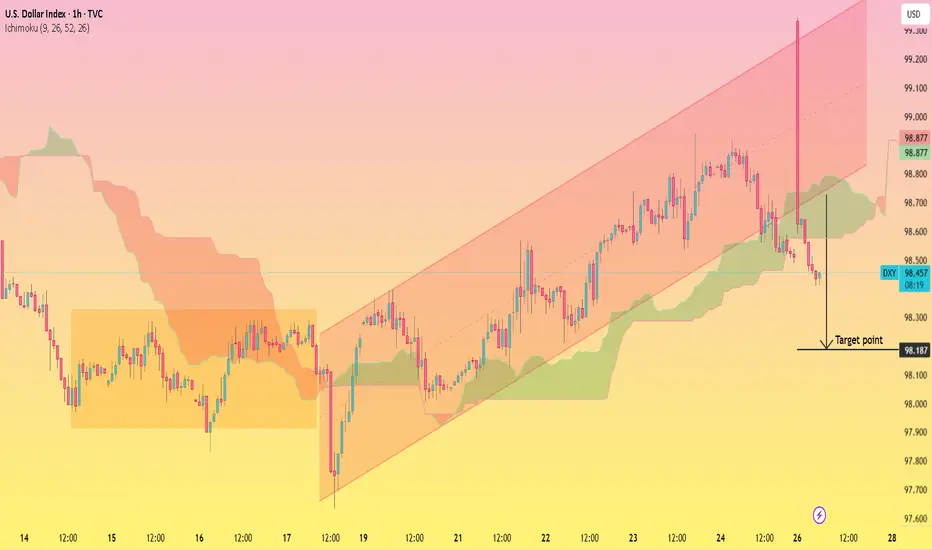
U.S. Dollar Index (DXY) — Bearish Pullback Toward 98.187 SupportThis 1-hour chart of the U.S. Dollar Index shows price previously trending upward within a rising channel, supported by the Ichimoku Cloud. After reaching the upper boundary, a sharp rejection (long wick spike) signals exhaustion. Price has since broken below short-term structure and is slipping toward the cloud support.
Momentum appears to be weakening, with lower highs forming and price edging closer to the lower channel boundary and cloud base.
**Target:**
* Downside target: **98.178** (marked horizontal support and projected move from the breakdown)
If price fails to hold above the cloud and channel support, continuation toward this level becomes likely. A reclaim of the cloud, however, would invalidate the bearish setup.
SOLANA Ascending Trendline Support with Bullish ContinuationThis 1H SOLANA chart shows a **gradual bullish structure** supported by a strong **ascending trendline** (green), where price continues to form higher lows. Earlier, price moved inside a rising channel before experiencing a sharp rejection (circled area), leading to a temporary bearish pullback.
After the correction, the market stabilized and resumed consolidation above the trendline, with the **Ichimoku cloud acting as dynamic support**. Price is currently ranging just below a minor resistance zone (around 86.50), indicating accumulation before a potential breakout.
The overall structure suggests that buyers are still in control as long as the trendline holds and price remains above the cloud.
**🎯 Target:**
* **Primary Target:** 88.60 – 88.70
* This aligns with the projected breakout move and previous resistance zone.
**⚠️ Key Levels to Watch:**
* Support: 85.50 – 86.00 (trendline + cloud support)
* Resistance: 86.50 → 88.60 (range high to target zone)
**💡 Insight:**
Holding above the ascending trendline keeps the **bullish bias intact**. A clean breakout above 86.50 can trigger momentum toward the target, while a breakdown below the trendline would weaken the setup and may lead to deeper retracement.
EURUSD: Rebounds From Support – Upward Channel Points to UpsideHello everyone, here is my breakdown of the current EURUSD setup.
Market Analysis
EURUSD previously traded inside a range, showing consolidation before a breakdown that confirmed bearish pressure. After the drop, price continued lower within a descending channel. Later, the market found a bottom and reversed, breaking out of the channel and shifting into a bullish structure with higher lows.
Currently, price is trading within an ascending channel, holding above the 1.1660 support zone while approaching the 1.1750 resistance zone. A recent pullback from resistance shows some selling pressure, while the trendline continues to act as dynamic support.
My Scenario & Strategy
As long as EURUSD holds above the 1.1660 support and respects the ascending channel, the bullish scenario remains valid. A bounce from support could push price toward the 1.1750 resistance (TP1).
However, if price breaks below 1.1660 and loses the channel structure, the bullish setup would weaken, opening the door for a deeper correction.
That’s the setup I’m tracking. Thank you for your attention, and always manage your risk.
ETHUSD Breakout from Range – Bullish Continuation in Play Ethereum (ETHUSD) has successfully broken out of a well-defined consolidation range after multiple days of sideways movement. The highlighted range zone acted as accumulation, with price respecting both support and resistance boundaries before building momentum.
A clear breakout occurred at the marked break zone, confirmed by strong bullish candles and sustained upward movement. This indicates buyers stepping in with conviction.
The current structure suggests:
Bullish continuation above the breakout level
Previous resistance now acting as support
Momentum favoring upside targets
Two key target zones are identified:
First target: Near-term resistance just below 2,360
Second target: Higher liquidity zone around 2,380–2,400
As long as price holds above the breakout area, the bullish bias remains intact. A retest of the breakout zone could offer potential continuation entries.
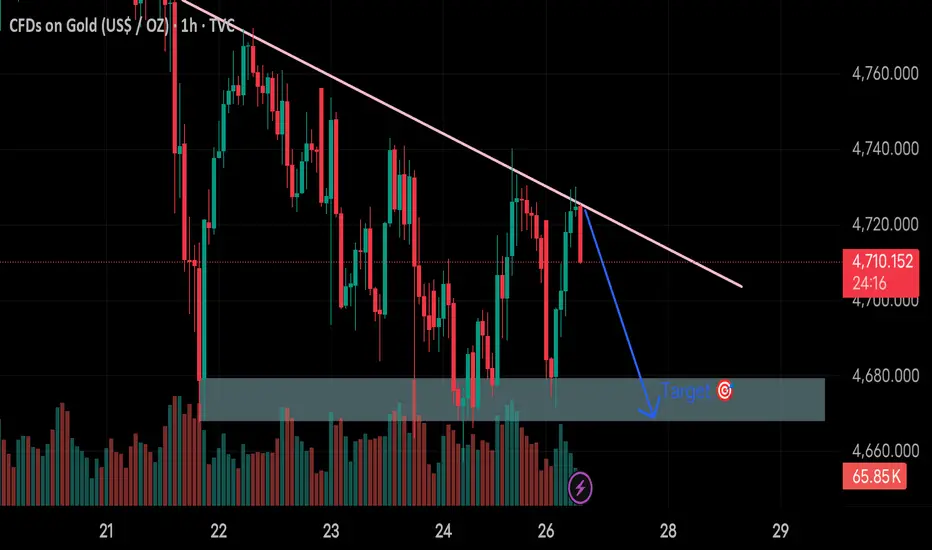
(Gold, 1H timeframe)...(Gold, 1H timeframe), the setup looks like a rejection from a descending trendline with a marked demand zone below.
📉 Short bias breakdown:
Price just tapped the trendline resistance
Rejection candles forming → sellers stepping in
Clear support/demand zone highlighted below
🎯 Target:
My marked zone is the correct area.
Primary target:
➡️ 4,670 – 4,680
🧠 How I’d read it:
First reaction likely around 4,690 (minor structure)
If momentum continues → full move into the demand zone
That zone is where buyers previously stepped in → expect bounce or consolidation
⚠️ Keep in mind:
If price breaks and closes above trendline, this setup is invalid
Watch volume — strong bearish volume supports the move
The Weekly FOREX Forecast: Best Setups For DXY, EURUSD, GBPUSDWelcome back to the Weekly Forex Forecast!
This will be the outlook for the week of April 27 - May 1st.
In this video, we will analyze the following FX markets:
USD Index
EURUSD
GBPUSD
Enjoy!
May profits be upon you.
Leave any questions or comments in the comment section.
I appreciate any feedback from my viewers!
Like and/or subscribe if you want more accurate analysis.
Thank you so much!
Disclaimer:
I do not provide personal investment advice and I am not a qualified licensed investment advisor.
All information found here, including any ideas, opinions, views, predictions, forecasts, commentaries, suggestions, expressed or implied herein, are for informational, entertainment or educational purposes only and should not be construed as personal investment advice. While the information provided is believed to be accurate, it may include errors or inaccuracies.
I will not and cannot be held liable for any actions you take as a result of anything you read here.
Conduct your own due diligence, or consult a licensed financial advisor or broker before making any and all investment decisions. Any investments, trades, speculations, or decisions made on the basis of any information found on this channel, expressed or implied herein, are committed at your own risk, financial or otherwise.
ETHEREUM - Huge Elliott Waves Formation Ethereum is currently approaching the final stage of a global accumulation phase, structured as a complex W–X–Y–X–Z correction , which began after the breakdown of the previous impulsive cycle (1–5) and the following ABC corrective move.
Macro Structure: After the completion of the bullish impulse (1–5), the market transitioned into a corrective regime, forming an extended and complex structure rather than a simple pullback:
The initial decline formed an ABC correction, marking the shift from trend to accumulation
This was followed by a broader WXYXZ formation, typical for prolonged accumulation phases in high-timeframe markets
The final Z-leg acted as a liquidity sweep, breaking below prior structure and forcing capitulation
Formation of the Current Range: The bottom formation (WXYXZ) created a structural floor, from which the current range developed. Since then:
Price has been consolidating within a rising channel / range
Volatility has been compressing under a major resistance zone
Market behavior aligns with re-accumulation rather than distribution
This suggests that the market is absorbing supply, not distributing it.
XY Development: From the upper resistance zone, price formed a corrective XY structure, which is critical for understanding current positioning:
Wave X → Y defined the internal corrective leg within the broader accumulation
The Y wave established a key support trendline (dynamic support)
This trendline is currently being respected, with price bouncing directly from it
This reaction confirms that the structure remains technically valid and buyers are defending higher lows within the range.
In conclusion , Ethereum appears to be in the final stage of a prolonged accumulation phase, where a completed correction and a well-defined structural support are now supporting the price. This combination suggests that the current consolidation is more likely a phase of compression before expansion rather than distribution. As long as key support levels hold, the chances of going up are much higher, with a breakout above resistance potentially marking the beginning of a new impulsive leg in the cycle.
BTC/USD: Intraday Long ExpectationsAnalytical Context:
The recent local decline has been temporarily halted by the emergence of a limit buyer. Price is currently reacting to last week’s POC (within the VP), indicating that we are trading at "cheap" values relative to the established range.
The inversion of local blocks further confirms the potential for a relief bounce.
Trading Plan:
Entry Zone (Long): $77,700$ – $77,600$
Main Target: $78,380$
Invalidation: $77,400$
Risk Management:
Maintain strict systemic risk management. Capital preservation is the priority: moving to breakeven is recommended after the initial impulse. Do not ignore the invalidation zone — trading without stop-orders is not an option.
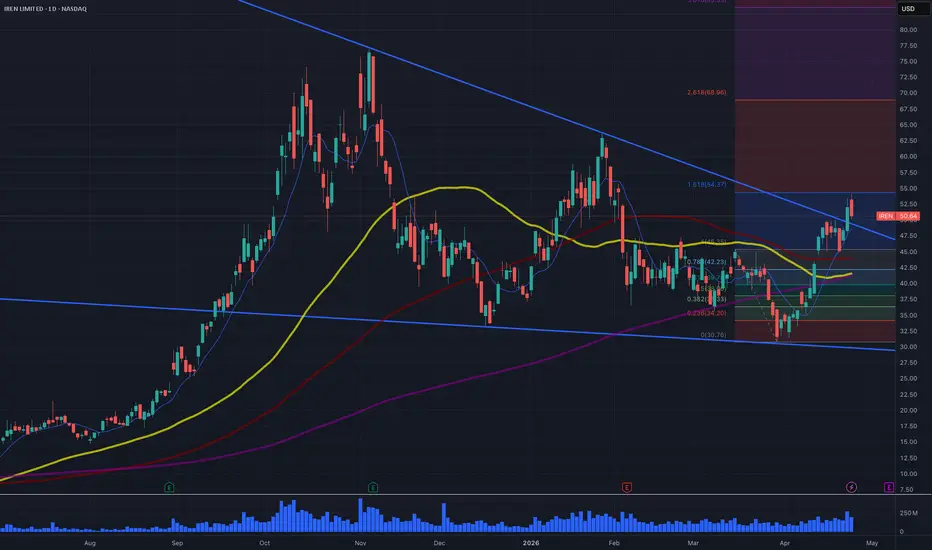
IREN: Critical Resistance Confluence – Make or Break MomentDescription:
IREN is currently testing a massive confluence of resistance, setting up a classic "make or break" scenario on the daily chart. While the underlying momentum is undeniably strong, the price action has just hit a brick wall, demanding patience before looking for a long entry.
The Resistance (The Ceiling)
The most critical feature right now is the immediate rejection we are seeing on the right edge of the chart. The price perfectly tapped a dual-layered resistance zone:
Macro Trendline : The descending trendline (blue) has successfully capped the price action since the peak late last year.
1.618 Fib Extension : Drawn from the recent base, the 1.618 extension sits precisely at $54.37.
After tagging this area, the recent daily price action shows a sharp rejection, pulling back to the $50.60s. This proves sellers are actively defending this confluence.
The Support Structure (The Floor)
Despite the rejection at the top, the structural setup that drove the price to this level is incredibly bullish:
Moving Average Bounce : The price established a rock-solid bottom around the $30.00 level, perfectly rejecting off the long-term moving average and the 0 Fib level ($30.76).
Bullish Momentum : The shorter-term moving averages have crossed bullishly and are sloping upward.
Fundamental Catalyst : Beyond the chart, the clean balance sheet coming out of the Q2 FY2026 reporting provides a strong fundamental floor to justify this high-volume rally.
The Trading Plan
Buying directly into a macro descending resistance line and a major Fibonacci extension offers a poor risk-to-reward ratio. I am watching two specific scenarios play out:
The Breakout : Waiting for a confirmed daily close above the blue trendline and the $54.37 level on high volume, turning that ceiling into a new floor.
The Pullback : Waiting to see if the price bases out and finds support at the 1 Fib level ($45.35) or the rising shorter-term moving averages before making another attempt at the trendline.