GBPCHF FREE SIGNAL|SHORT|
✅GBPCHF trades into a clean ICT supply zone after strong bullish displacement, showing signs of exhaustion and potential buy-side liquidity sweep. Expect bearish reaction as smart money shifts order flow lower toward inefficiencies below.
—————————
Entry: 1.0622
Stop Loss: 1.0632
Take Profit: 1.0606
Time Frame: 3H
—————————
SHORT🔥
✅Like and subscribe to never miss a new idea!✅
Community ideas
Bullish bounce off overlap support?EUR/GBP is falling towards the support level which is an overlap support that aligns with the 61.8% Fibonacci projection and could bounce from this level to our take profit.
Entry: 0.8643
Why we like it:
There is an overlap support level whichis aigns with the 61.8% Fibonacci retracement.
Stop loss: 0.8613
Why we like it:
There a pullback support level.
Take profit: 0.8675
Why we like it:
There iss an overlap resistance level.
Enjoying your TradingView experience? Review us!
Please be advised that the information presented on TradingView is provided to Vantage (‘Vantage Global Limited’, ‘we’) by a third-party provider (‘Everest Fortune Group’). Please be reminded that you are solely responsible for the trading decisions on your account. There is a very high degree of risk involved in trading. Any information and/or content is intended entirely for research, educational and informational purposes only and does not constitute investment or consultation advice or investment strategy. The information is not tailored to the investment needs of any specific person and therefore does not involve a consideration of any of the investment objectives, financial situation or needs of any viewer that may receive it. Kindly also note that past performance is not a reliable indicator of future results. Actual results may differ materially from those anticipated in forward-looking or past performance statements. We assume no liability as to the accuracy or completeness of any of the information and/or content provided herein and the Company cannot be held responsible for any omission, mistake nor for any loss or damage including without limitation to any loss of profit which may arise from reliance on any information supplied by Everest Fortune Group.
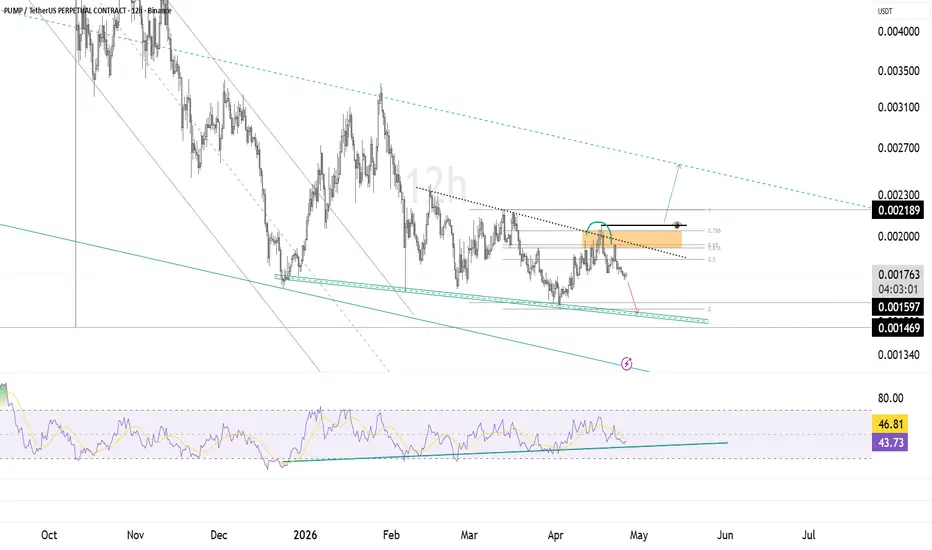
PUMP Rejection at Key Supply – Downtrend Still in ControlPUMP remains inside a broader descending structure, and the recent move into the highlighted zone has been met with clear resistance.
Price tapped into a key supply / fib confluence area (0.618–0.786) and failed to break above, forming a lower high. This confirms that sellers are still defending the trend.
With price now drifting lower and sitting above a fragile support, a breakdown from the 0.00159–0.00146 zone could trigger continuation toward deeper levels.
Unless PUMP reclaims and holds above the resistance zone, this remains a bearish continuation setup, not a reversal.
EURNZD DEMAND LEVEL AHEAD|LONG|
✅EURNZD will soon react from a strong ICT demand zone after a selloff, where we will see early signs of bullish displacement and potential shift in order flow. Liquidity below lows will be taken, favoring continuation toward higher inefficiencies and upside targets. Time Frame 5H.
LONG🚀
✅Like and subscribe to never miss a new idea!✅
NSE – NIFTY 750 | Eris Lifesciences Ltd | 27 Apr 2026Regime Shift Structure → Expansion Phase
Trend: Uptrend | Location: Upper Zone | Behaviour: Impulsive
Structure assessed from earliest reliable data
Base formation → regime shift structure
Showing impulsive behaviour within trend
Part of the NIFTY 750 Structural Census.
For educational purposes. Structural market observation.
Structure → Level → Trigger → Probability
#NF750Census #MarketStructure #ERIS
AAPL Top-Down Analysis | Liquidity, Confluence & EMA Structure In today’s review of Apple (AAPL), I walk through my top-down analysis process using the tools I keep on my chart to help build context and identify higher-probability areas of interest.
This review focuses on how I use the 13 and 21 EMA, supply and demand zones, and extended-hours session levels in TradingView to better understand where price may be leaning.
Rather than relying on one signal alone, the goal is to build confluence by combining multiple context clues from price action, liquidity behavior, and structure.
A major focus in this review is understanding how liquidity influences price movement and how those clues can help build a case for where price may be targeting next.
In this video, I cover:
• How I use the 13 and 21 EMA to read short-term structure
• Identifying supply and demand zones that may influence price
• Using extended-hours levels as additional liquidity reference points
• Building confluence through liquidity, structure, and price clues
This approach is designed to simplify the chart, reduce noise, and focus on how price behaves around important areas rather than forcing a prediction.
As always, the focus remains on confirmation over prediction.
#ZEUSUSDT Forming Bullish Momentum#ZEUS
The price is moving within a descending channel on the hourly timeframe. It has reached the lower boundary and is trending towards a bounce. A retest of this boundary is expected.
The Relative Strength Index (RSI) indicates a downward trend, and this trend is likely to continue due to the overbought condition.
A key support zone (in green) was found at 0.005800, and the price has bounced off this zone several times, making it a strong support level.
The price is trending towards the 100-period moving average, which we are approaching. This trend supports an upward move.
Entry Price: 0.007100
First Target: 0.007690
Second Target: 0.008370
Third Target: 0.009093
You can close at the second target or wait for the third target to be reached. The choice is yours.
Stop Loss: At the resistance zone (in green).
Remember this simple rule: Money Management.
Any questions? Please leave a comment.
Thank you.
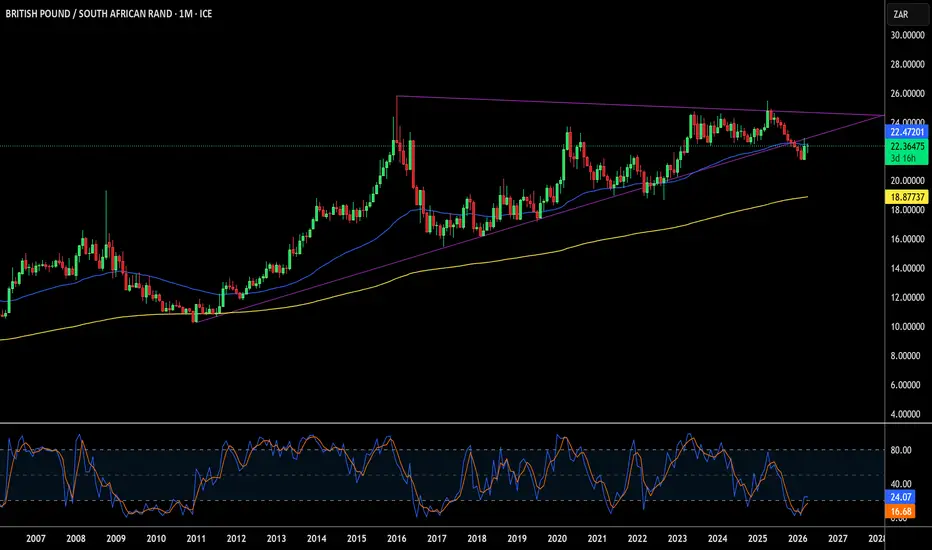
GBP/ZAR Forecast 2026: Multi-Domain AnalysisMacroeconomics and Economics
The GBP/ZAR exchange rate recently consolidated near the 22.30 mark. Strong UK GDP data supports Pound Sterling. These figures empower the Bank of England to maintain strict monetary policies. Conversely, South Africa faces mounting inflation risks. The South African Reserve Bank (SARB) warns that surging energy costs threaten economic stability. However, robust domestic retail sales provide the Rand with intermittent support. Currency trajectories depend heavily on these shifting macroeconomic indicators. Analysts project a near-term trading range between 21.80 and 22.80.
Geopolitics and Geostrategy
Global geopolitical tensions heavily influence the Rand. The ongoing Iran conflict directly impacts global oil prices. This geostrategic friction dictates broader market risk sentiment. As an emerging market currency, the Rand remains hyper-sensitive to these external shocks. Stable global markets typically strengthen the ZAR. Conversely, any sudden escalation in Middle Eastern hostilities will immediately depreciate the currency. Geopolitics consistently override local economic data during international crisis periods.
Industry Trends and Business Models
Volatile exchange rates force industries to adapt rapidly. Rising energy expenses disrupt traditional manufacturing business models in South Africa. Companies must pivot toward sustainable, cost-effective operational frameworks. Meanwhile, the UK service sector thrives on stable industry trends. Corporate strategists monitor these currency fluctuations to optimize cross-border trade. Agile business models actively mitigate the inherent risks of forex volatility.
Management, Leadership and Company Culture
Currency volatility aggressively tests corporate leadership. Executive management teams must deploy robust hedging strategies to protect profit margins. Modern company culture demands exceptional adaptability from internal finance departments. Leaders who foster innovative thinking navigate these financial turbulence metrics successfully. SARB officials also demonstrate assertive leadership by transparently addressing inflation risks. Effective management directly correlates with financial resilience in both nations.
Technology and Cybersecurity
Fintech advancements continuously revolutionize forex trading execution. High-frequency algorithms process GBP/ZAR trades in mere milliseconds. This technological reliance introduces critical cybersecurity vulnerabilities. Financial institutions deploy advanced encryption to protect multi-billion-dollar daily transaction volumes. A single cyber breach can easily destabilize institutional trading floors. Therefore, cybersecurity investments remain non-negotiable for forex brokers and multinational banks alike.
Science, High-Tech, and Patent Analysis
Economic strength increasingly relies on high-tech innovation. The UK consistently drives economic growth through aggressive patent filings and scientific research. This intellectual property dominance supports long-term Sterling valuation. South Africa aggressively expands its high-tech infrastructure to compete globally. Analyzing regional patent data reveals lucrative emerging tech hubs in both nations. These scientific advancements attract vital foreign direct investment. Ultimately, sustained high-tech innovation fortifies fundamental currency strength.
Gold Price Forecast | Oil | Dollar | Silver | Natural Gas.0:00 — Introduction & Market Overview
A brief look at the commodities covered today and a recap of the previous stock market update.
0:22 — Natural Gas (NG) NYMEX:NG1!
Analysis of the current weekly downtrend and why bears remain in control despite a slight trend line break. Key support levels are identified at 2.4 and 2.6.
5:52 — Oil (CL) NYMEX:CL1!
Oil moves into a neutral trend after breaking a higher low pivot. Discussion on geopolitical tensions and the importance of a "shallow pullback" to maintain bullish momentum.
8:24 — US Dollar (DXY)
The dollar continues to trade within a long-term megaphone pattern. Analysis of the 2027 rate cut probabilities and the upcoming FOMC meeting impact.
9:58 — Gold (GC) COMEX:GC1!
Gold shows signs of a rare weekly downtrend after a bear break from a rising wedge. Levels to watch for a potential long-term top if support at 4131 fails.
12:23 — Silver (SI) COMEX:SI1!
Silver is showing relative weakness compared to Gold. A look at the falling wedge pattern and the critical 72.5 level that needs to hold to maintain the daily uptrend.
14:06 — Outro & Summary
Final thoughts and a reminder to check out the S&P 500 and Bitcoin analysis from the previous video.
US500 (S&P): Trend in daily time frameThe color levels are very accurate levels of support and resistance in different time frames, and we have to wait for their reaction in these areas.
So, Please pay special attention to the very accurate trend, colored levels,
and you must know that SETUP is very sensitive.
Be careful
BEST
MT
Skyworks Solutions (SWKS)Skyworks Solutions (SWKS) — Buy Idea (Trend Reversal)
A potential mid-term reversal scenario is being considered after a prolonged downtrend. The price is showing signs of stabilization and accumulation near local lows, which may indicate weakening selling pressure and a gradual shift in control toward buyers.
The 63–65 zone is viewed as an attractive area to build a long position, as it represents a potential consolidation base and emerging support. If buying interest is confirmed, an upward impulse could develop, leading to a sustained move higher.
The target is set at 120, corresponding to a return to previous distribution zones and strong resistance levels on higher timeframes.
Risk is managed with a stop-loss at 54, below a key support level. A break below this level would invalidate the reversal scenario and suggest continuation of the downtrend.
Idea: early positioning for a trend reversal with strong upside potential and controlled risk.
SPX: Highly overbought ahead of FOMCThe S&P 500 reached a fresh, new all time highest level at 7,163 on Friday, but struggled to hold gain, ultimately pulling back at the end of the trading day, as investor sentiment turned more cautious. The move was driven primarily by rising geopolitical tensions in the Middle East, particularly uncertainty around U.S.–Iran developments and the stability of the Strait of Hormuz, which pushed oil prices higher and reignited inflation concerns. From a macro perspective, elevated energy prices and fragile ceasefire conditions have increased market sensitivity to potential supply shocks, complicating the outlook for inflation and monetary policy.
Performance within the S&P 500 this week was largely driven by a narrow group of sectors, with information technology and semiconductors clearly outperforming, supported by strong earnings and continued AI-driven demand. Investor inflows also favored technology, industrials, and financials, reflecting improving sentiment around growth and earnings resilience. On the downside, energy and communication services lagged, pressured by volatility in oil prices and broader geopolitical uncertainty, particularly related to tensions in the Middle East.
Intel stock took the central attention of investors, with a sharp increase in price, after a significant earnings beat and upbeat forward guidance. Shares jumped more than 20–25%, reaching record highs, driven by stronger-than-expected revenue and accelerating demand for AI-related data center CPUs. The rally was further supported by robust growth in its data center segment and optimistic forecasts for the coming quarter, reinforcing investor confidence in Intel’s turnaround story.
Despite recent record highs, the S&P 500 is facing short-term pressure as investors reassess risk exposure amid an increasingly uncertain geopolitical backdrop. Also the next week brings FOMC meeting and Feds interest rate decision, which will add to the level of nervousness among investors. Some precaution with optimism should be advisable.
MARKETS week ahead: April 26 – May 2Last week in the news
Elevated energy costs and fragile geopolitical conditions, increased fears of supply shocks, clouded outlook for inflation and monetary policy continue to be major concerns of investors. Nevertheless, the S&P 500 hit a new all-time high at 7,163 points on Friday but later reversed gains as sentiment turned cautious. The price of gold continues to hold higher grounds regardless of a modest pullback toward the $4.708. US 10Y Treasury yields are trying hard to find some ground, finishing another week at elevated levels of 4,3%. The crypto market also manages to find momentum with the latest BTC attempt to test the $80K resistance. Still, the coin closes the week around $77K.
Posted macro data for the U.S. showed stronger-than-expected U.S. Retail Sales data, which rose 1.7% m/m in March versus forecasts of 1.1%, while annual growth reached 4%, well above the 2.4% consensus. Consumer sentiment data from the University of Michigan for April came in at 49.8, slightly above expectations of 47.6. Meanwhile, five-year inflation expectations edged higher to 3.5% from 3.2%, indicating a modest rise in longer-term price concerns. The week ahead brings the FOMC meeting, where the Fed will discuss current levels of interest rates. According to the latest CME FedWatch, markets are overwhelmingly expecting the Federal Reserve to hold interest rates steady.
Intel stock moved into focus this week, posting a sharp rally following a strong earnings beat and optimistic forward guidance. Shares surged more than 20–25%, reaching record levels, supported by better-than-expected revenue and rising demand for AI-driven data center CPUs. The move was further underpinned by solid growth in the data center segment and a constructive outlook for the next quarter, strengthening confidence in the company’s turnaround. Overall, Intel emerged as a key driver of the broader semiconductor rally, with positive spillovers across the tech sector as markets continue to price in sustained AI demand.
The latest CNBC report highlights that a sharp AI talent war is intensifying between enterprise software companies and major AI players like OpenAI, as firms compete aggressively for experienced executives. Several senior leaders from companies such as Salesforce, Snowflake, and Palantir are being recruited with highly attractive compensation packages and the promise of direct access to enterprise clients and revenue growth opportunities. This shift reflects how AI companies are increasingly targeting the enterprise software market as a key growth engine, turning executive hiring into a strategic battleground for scaling adoption and market share.
Nvidia stock closed at a record high, pushing its market capitalization above $5 trillion for the first time, driven by continued strong demand for AI-related chips. The rally was supported by broad strength across the semiconductor sector, particularly following upbeat earnings from key industry peers, which reinforced investor confidence in AI infrastructure growth. Overall, Nvidia’s surge reflected sustained optimism around artificial intelligence as a dominant market theme, with spillover gains across the broader tech sector.
CRYPTO MARKET
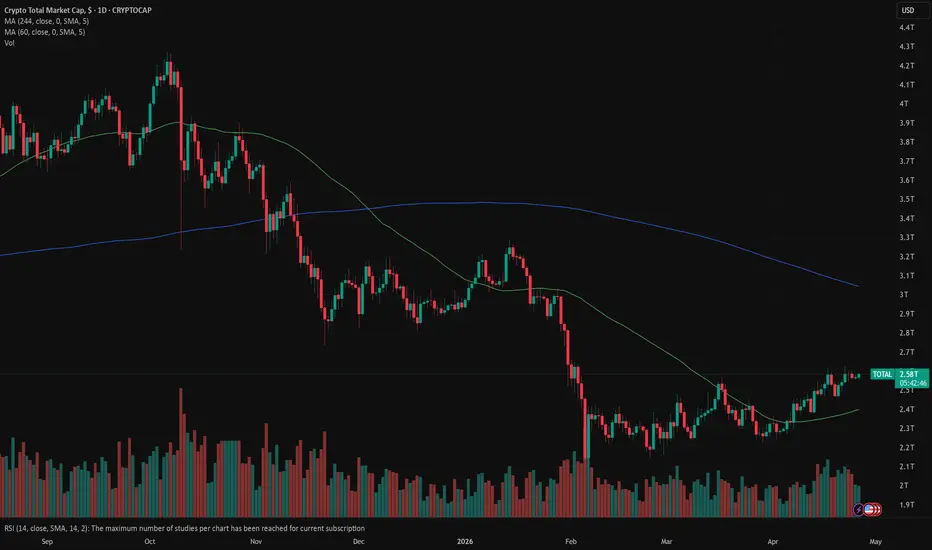
A relatively mixed week is behind the crypto market, with performance diverging across major assets and a lack of clear directional momentum. While Bitcoin managed to extend gains, several altcoins experienced mild corrections, pointing to a more selective market environment. Total crypto market capitalization was increased by 1,1% w/w, adding $27B to its market cap. Daily trading volumes were modestly decreased to the level of $213B, from last week's $307B. Total market capitalization since the beginning of this year currently stands in a negative territory of -13%, with a total outflow of -$369B.
BTC and ETH once again set the tone for the market. Bitcoin continued its upward move, gaining 2.1% on a weekly basis, while Ethereum underperformed with a 1.9% w/w decline, indicating some rotation away from the second-largest asset. Among other major cryptocurrencies, performance was mixed. XRP declined slightly by 0.5%, while BNB remained broadly flat (-0.2%). Solana also showed minimal change (-0.02%), reflecting consolidation at current levels.
Among the strongest performers within the major list, Zcash stood out with a solid 10.4% weekly gain, Monero also delivered a strong performance, rising 7.9%, while Algorand gained 6.3% and Maker advanced 4.6%. Additional upside was seen in POL (+3.8%) and DASH (+2.9%). On the negative side, Hyperliquid recorded the largest decline, falling 6.7% w/w, followed closely by THETA with a 6.3% drop and OMG Network down 6.0%. Uniswap also declined 3.7%, while Polkadot lost 2.5% and SUI slipped 2.0%, indicating mild but broad-based pressure across parts of the altcoin segment.
Outside of the majors, several tokens delivered notable upside performance. Humanity Protocol recorded a 25.0% weekly gain, while Stable increased by 25.2%, and Chiliz advanced by 21.9% w/w, placing them among the top performers in the broader market.
Circulating supply dynamics showed some more visible changes this week. Polkadot recorded the largest increase in supply of a 0.6% increase. Stellar expanded supply by 0.3%, while XRP and IOTA both saw 0.2% increases. Several other assets, including DOGE, Cardano, DASH, Zcash, Solana and Filecoin, recorded 0.1% growth. On the downside, Hyperliquid and Uniswap both posted slight 0.1% decreases in circulating supply.
CRYPTO FUTURES MARKET
Bitcoin futures showed a largely stable performance this week, with only marginal changes across the curve following the strong upward momentum observed in prior weeks. The April 2026 maturity increased slightly by 0.44% w/w, settling at $77,940, while most other maturities recorded minimal gains in the range of 0.06% to 0.18%. Longer dated futures remained similarly steady, with the December 2027 maturity closing at $84,865, up just 0.10% on the week. The muted price action suggests a pause in momentum, with the market entering a consolidation phase after the recent rally.
In contrast, Ether futures experienced a notable pullback, reversing part of the gains from previous weeks. The April 2026 contract settled at $2,312, declining 5.01% w/w. Across the curve, losses ranged between 4.47% and 5.01%, indicating a broad based correction. The December 2027 maturity closed at $2,557, down 4.55% on the week. The consistency of declines across maturities points to a parallel downward adjustment rather than localized pressure.
It is also worth noting that October 2026 futures appeared on the curve for the first time this week for both Bitcoin and Ether, with initial pricing at $79,720 and $2,385, respectively.
Overall, the week reflects a divergence in market dynamics, with Bitcoin futures stabilizing while Ether futures undergo a meaningful correction. Despite these differing short-term trends, both futures curves remain in contango, indicating that longer-term expectations continue to be priced at higher levels relative to near-term maturities.
Silver Stabilizing With Gradual Upside ScenarioAfter a strong decline, price action is now stabilizing and forming a more balanced structure. The presence of higher lows indicates early signs of strength building in the market.
The projected path suggests a pullback toward support followed by a gradual move upward. Continuation depends on price maintaining above the recent base.
Key Areas:
Support Range: 74.80 – 75.20
Mid Zone: 76.00 – 76.50
Resistance: 78.00 – 78.50
Target Levels:
76.70
78.00
79.80 – 80.50
Trading Idea: MU Breakout Continuation Setup (4H)Micron (MU) is compressing under a clear horizontal resistance around $525, with higher lows forming underneath — a classic ascending triangle structure. Price is respecting a rising trendline while volume (OBV ribbon) trends upward, suggesting accumulation.
At the same time, OBV RSI shows bullish divergence (price relatively flat vs. momentum improving), which supports the probability of a breakout.
Plan:
Entry (Breakout):
Buy on a confirmed 4H close above $525
Alternative Entry (Pullback):
Wait for breakout → retest of $520–525 zone → enter on support hold
Stop Loss:
Below $485–490 (under structure / last consolidation)
Targets:
TP1: $600 (psychological + measured move)
TP2: $700–750 (extension zone)
TP3 (only if momentum accelerates): $900–1000 (parabolic scenario, not base case)
Key Read:
Trend = bullish
Structure = compression before expansion
Volume = supportive
Momentum = recovering
Important Note:
A move to $1000 would likely require acceleration + hype + strong macro/AI narrative continuation — not just a technical breakout. So treat that as a runner scenario, not the main expectation.
SPX (Daily). Overbought, RSI indicating a short term top?Markets are at overbought levels with animal spirits in overdrive. I am reducing my exposure here and waiting for markets to cool down a bit. I continue to swing trade stocks with momentum until we lose the 22d SMA (currently ~6,800). My price target on SP:SPX is ~$7360 to ~-$7400 before seeing a modest correction (10-15%) which I think will happen over the summer or before. I have indicated with red arrows where SPX has performed at key overbought levels going back to April of 2025. Also notice that we are not getting any help from financials or healthcare in the recent rally, which is concerning to me. SOXX, which has been leading is at extreme overbought levels.
US 10Y TREASURY: Volatility ahead of the FOMCThe 10Y U.S. Treasury yields traded in a volatile manner this week as markets reacted to shifting expectations around Middle East developments and U.S.–Iran ceasefire dynamics. Early optimism that geopolitical tensions were easing briefly pushed yields lower, as oil prices declined and inflation fears softened. However, that move reversed as ceasefire optimism faded and markets reassessed the persistence of supply risks through the Strait of Hormuz, supporting a rebound in yields.
At the same time, macro data showing resilient inflation pressures and ongoing fiscal concerns kept the broader yield backdrop elevated. The 10Y yields were moving between 4,24% up to 4,35%. They closed the week at 4,31%. For the week ahead, the volatility might continue. The most important event for the week ahead is the FOMC meeting, which will be held on Wednesday. On this day, it could be expected that the market will be at a peak of nervousness. On the other hand, geopolitics and energy-driven inflation risks will continue to be the dominant drivers of direction in the Treasury market also in the coming period. In this sense, levels below the 4,4% could be tested for one more time. Also there is the same probability for yields to ease down toward the 4,2% supporting levels.
GOLD: Caught in macro risks?Gold posted a volatile week and is on track for its first weekly decline in five weeks, pressured by shifting geopolitical and macro conditions tied to the ongoing Iran war. Earlier in the week, renewed tensions and uncertainty around the Strait of Hormuz initially supported safe-haven demand, but this was offset as market focus shifted toward a stronger U.S. dollar and rising Treasury yields. The move higher in yields reduced gold’s relative attractiveness, while easing expectations of near-term policy support added further pressure. Despite intermittent rebounds on geopolitical headlines, gold ultimately struggled to sustain gains as risk sentiment stabilized. Overall, the price action reflects a market caught between persistent geopolitical risk and tightening financial conditions.
The price of gold was moving in a relatively shorter range, between levels of $4.823 down to $4.664. The RSI continues to move below the level of 50, around the 46, indicating that investors are still not clearly eyeing the overbought market side. The MA50 is slowly converging toward the MA200, but due to distance between lines, the cross is not in a near term prospectus.
The week ahead brings FOMC meeting and Fed's rate decision, which might make investors nervous. Increased volatility is quite possible during this time. Based on current charts, the price of gold is more bearish than bullish, but is sustaining higher levels due to ongoing inflation risks. In case that the price turns toward downside, the next level to watch will be $4,6K. At this moment, there is only a modest potential for the upside move, in which case gold could test one more time the level of $4.820. It should be considered that there is a lower probability for such a move in the week ahead.
Forecast: Bitcoin x 100, by 2029Bitcoin has now retraced back to the second downsloping channel, marked as “Windfall.” In essence, a Windfall is a wider version of a trend barrier, which I prefer over single trendlines because it gives price more structural context.
In my framework, two consecutively broken Windfall barriers originating from the same region form one of the strongest bullish signals . When price later retraces back to the second broken barrier, I view that as a high-quality entry opportunity.
We are currently at such a potential entry point. Price has also recently interacted with the orange support line. This line is essentially a modified lower Bollinger Band, set to 50 periods and slightly smoothed, with filtering applied to reduce the impact of extreme outlier moves.
According to @EdgeTools, mean reversion after lower-band penetration produced statistically significant results, especially for long trades. See the related idea for more details.
Although I use the modified lower Bollinger Band as a supporting signal within the entry framework, I do not use the Bollinger mean as my target. Instead, I am aiming for the center median line of the newly formed pitchfork.
Because price history widens over time, pivot B had to be migrated to the left to preserve the proper slope of the median lines. If pivot C is correct, then price should have a statistical probability of around 80% of reaching the next median line.
For the target level and maturity duration, I copied the initial impulse leg and projected it from point C. In my experience, price often tends to mimic the slope and flow of the first major action.
On a lower timeframe, I also see the possibility of a pullback toward the local trend barrier, which could provide a more refined entry opportunity around 73,100 .