
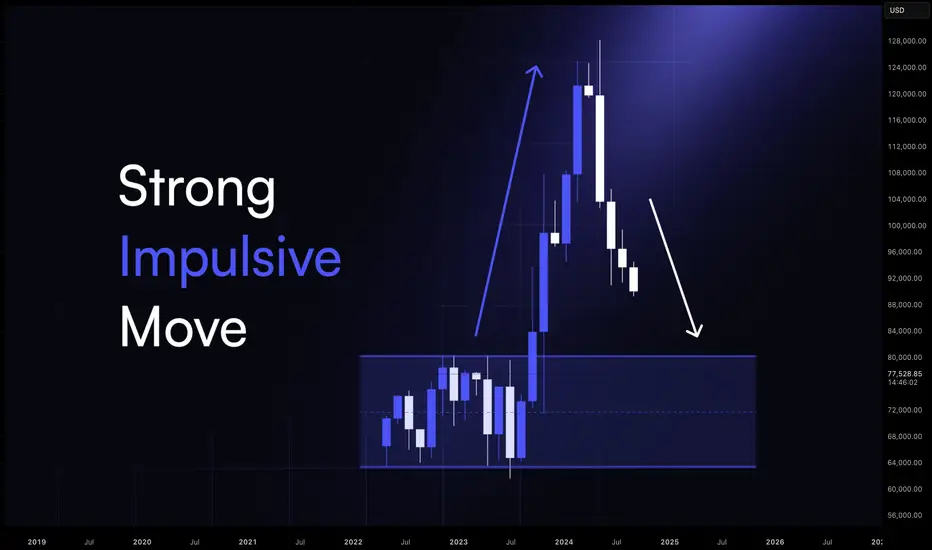
One of the recurring behaviors in financial markets is the tendency for price to revisit areas where strong moves originally began. Traders often notice this pattern but struggle to understand why it happens.
The explanation lies in how orders are executed during rapid price movement.
When the market moves slowly, buyers and sellers transact gradually. Orders are matched efficiently and price progresses in a balanced manner. Each level receives enough participation for trades to be completed smoothly.
Strong directional moves behave differently.
During rapid expansion, price moves faster than orders can be evenly matched. Aggressive buying or selling pushes the market quickly through several price levels, leaving limited trading activity behind. This creates areas where transactions were incomplete or uneven.
These areas represent imbalances in the market.

An imbalance does not mean price must immediately reverse. Instead, it means that the market passed through the area too quickly for normal two-sided participation to occur. Because of this, there are often unfilled or partially filled orders remaining within that zone.
Over time, the market tends to revisit these locations.
When price returns to the origin of a strong move, several things can happen. Traders who missed the original move may enter positions. Institutions may complete portions of larger orders that could not be fully executed during the initial expansion. The additional participation helps rebalance the order flow.
This process often produces reactions or temporary pauses in price movement.
The concept can be observed across many timeframes. A strong impulsive move followed by a pullback frequently retraces toward the base or starting point of that movement before continuing in the original direction.
Importantly, this behavior does not guarantee reversal.
Sometimes price returns briefly to the origin of the move and then resumes its previous trend. In other cases, the revisit leads to deeper rotation or a full shift in structure. The outcome depends on the balance of participation at the time.
Understanding this dynamic helps traders avoid chasing price after large expansions.
When a move has already traveled far from its starting point, the probability of retracement increases because the market may need to rebalance the inefficiencies created during the rapid movement.
Instead of entering late in the move, traders often wait for price to return closer to the origin where risk becomes easier to manage and participation can be evaluated more clearly.
Markets do not move in straight lines indefinitely.
Rapid expansion often leaves unfinished business behind.
When price revisits those areas, the market has an opportunity to complete transactions that could not occur during the initial surge.
The explanation lies in how orders are executed during rapid price movement.
When the market moves slowly, buyers and sellers transact gradually. Orders are matched efficiently and price progresses in a balanced manner. Each level receives enough participation for trades to be completed smoothly.
Strong directional moves behave differently.
During rapid expansion, price moves faster than orders can be evenly matched. Aggressive buying or selling pushes the market quickly through several price levels, leaving limited trading activity behind. This creates areas where transactions were incomplete or uneven.
These areas represent imbalances in the market.
An imbalance does not mean price must immediately reverse. Instead, it means that the market passed through the area too quickly for normal two-sided participation to occur. Because of this, there are often unfilled or partially filled orders remaining within that zone.
Over time, the market tends to revisit these locations.
When price returns to the origin of a strong move, several things can happen. Traders who missed the original move may enter positions. Institutions may complete portions of larger orders that could not be fully executed during the initial expansion. The additional participation helps rebalance the order flow.
This process often produces reactions or temporary pauses in price movement.
The concept can be observed across many timeframes. A strong impulsive move followed by a pullback frequently retraces toward the base or starting point of that movement before continuing in the original direction.
Importantly, this behavior does not guarantee reversal.
Sometimes price returns briefly to the origin of the move and then resumes its previous trend. In other cases, the revisit leads to deeper rotation or a full shift in structure. The outcome depends on the balance of participation at the time.
Understanding this dynamic helps traders avoid chasing price after large expansions.
When a move has already traveled far from its starting point, the probability of retracement increases because the market may need to rebalance the inefficiencies created during the rapid movement.
Instead of entering late in the move, traders often wait for price to return closer to the origin where risk becomes easier to manage and participation can be evaluated more clearly.
Markets do not move in straight lines indefinitely.
Rapid expansion often leaves unfinished business behind.
When price revisits those areas, the market has an opportunity to complete transactions that could not occur during the initial surge.

Related publications
Disclaimer
The information and publications are not meant to be, and do not constitute, financial, investment, trading, or other types of advice or recommendations supplied or endorsed by TradingView. Read more in the Terms of Use.
Related publications
Disclaimer
The information and publications are not meant to be, and do not constitute, financial, investment, trading, or other types of advice or recommendations supplied or endorsed by TradingView. Read more in the Terms of Use.