
Last week in the news
Elevated energy costs and fragile geopolitical conditions, increased fears of supply shocks, clouded outlook for inflation and monetary policy continue to be major concerns of investors. Nevertheless, the S&P 500 hit a new all-time high at 7,163 points on Friday but later reversed gains as sentiment turned cautious. The price of gold continues to hold higher grounds regardless of a modest pullback toward the $4.708. US 10Y Treasury yields are trying hard to find some ground, finishing another week at elevated levels of 4,3%. The crypto market also manages to find momentum with the latest BTC attempt to test the $80K resistance. Still, the coin closes the week around $77K.
Posted macro data for the U.S. showed stronger-than-expected U.S. Retail Sales data, which rose 1.7% m/m in March versus forecasts of 1.1%, while annual growth reached 4%, well above the 2.4% consensus. Consumer sentiment data from the University of Michigan for April came in at 49.8, slightly above expectations of 47.6. Meanwhile, five-year inflation expectations edged higher to 3.5% from 3.2%, indicating a modest rise in longer-term price concerns. The week ahead brings the FOMC meeting, where the Fed will discuss current levels of interest rates. According to the latest CME FedWatch, markets are overwhelmingly expecting the Federal Reserve to hold interest rates steady.
Intel stock moved into focus this week, posting a sharp rally following a strong earnings beat and optimistic forward guidance. Shares surged more than 20–25%, reaching record levels, supported by better-than-expected revenue and rising demand for AI-driven data center CPUs. The move was further underpinned by solid growth in the data center segment and a constructive outlook for the next quarter, strengthening confidence in the company’s turnaround. Overall, Intel emerged as a key driver of the broader semiconductor rally, with positive spillovers across the tech sector as markets continue to price in sustained AI demand.
The latest CNBC report highlights that a sharp AI talent war is intensifying between enterprise software companies and major AI players like OpenAI, as firms compete aggressively for experienced executives. Several senior leaders from companies such as Salesforce, Snowflake, and Palantir are being recruited with highly attractive compensation packages and the promise of direct access to enterprise clients and revenue growth opportunities. This shift reflects how AI companies are increasingly targeting the enterprise software market as a key growth engine, turning executive hiring into a strategic battleground for scaling adoption and market share.
Nvidia stock closed at a record high, pushing its market capitalization above $5 trillion for the first time, driven by continued strong demand for AI-related chips. The rally was supported by broad strength across the semiconductor sector, particularly following upbeat earnings from key industry peers, which reinforced investor confidence in AI infrastructure growth. Overall, Nvidia’s surge reflected sustained optimism around artificial intelligence as a dominant market theme, with spillover gains across the broader tech sector.
CRYPTO MARKET
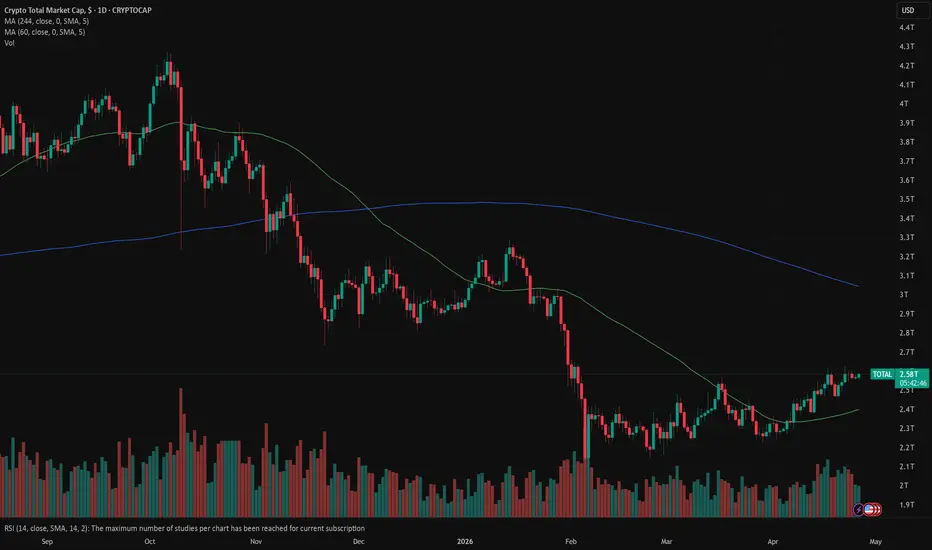
A relatively mixed week is behind the crypto market, with performance diverging across major assets and a lack of clear directional momentum. While Bitcoin managed to extend gains, several altcoins experienced mild corrections, pointing to a more selective market environment. Total crypto market capitalization was increased by 1,1% w/w, adding $27B to its market cap. Daily trading volumes were modestly decreased to the level of $213B, from last week's $307B. Total market capitalization since the beginning of this year currently stands in a negative territory of -13%, with a total outflow of -$369B.
BTC and ETH once again set the tone for the market. Bitcoin continued its upward move, gaining 2.1% on a weekly basis, while Ethereum underperformed with a 1.9% w/w decline, indicating some rotation away from the second-largest asset. Among other major cryptocurrencies, performance was mixed. XRP declined slightly by 0.5%, while BNB remained broadly flat (-0.2%). Solana also showed minimal change (-0.02%), reflecting consolidation at current levels.
Among the strongest performers within the major list, Zcash stood out with a solid 10.4% weekly gain, Monero also delivered a strong performance, rising 7.9%, while Algorand gained 6.3% and Maker advanced 4.6%. Additional upside was seen in POL (+3.8%) and DASH (+2.9%). On the negative side, Hyperliquid recorded the largest decline, falling 6.7% w/w, followed closely by THETA with a 6.3% drop and OMG Network down 6.0%. Uniswap also declined 3.7%, while Polkadot lost 2.5% and SUI slipped 2.0%, indicating mild but broad-based pressure across parts of the altcoin segment.
Outside of the majors, several tokens delivered notable upside performance. Humanity Protocol recorded a 25.0% weekly gain, while Stable increased by 25.2%, and Chiliz advanced by 21.9% w/w, placing them among the top performers in the broader market.
Circulating supply dynamics showed some more visible changes this week. Polkadot recorded the largest increase in supply of a 0.6% increase. Stellar expanded supply by 0.3%, while XRP and IOTA both saw 0.2% increases. Several other assets, including DOGE, Cardano, DASH, Zcash, Solana and Filecoin, recorded 0.1% growth. On the downside, Hyperliquid and Uniswap both posted slight 0.1% decreases in circulating supply.
CRYPTO FUTURES MARKET
Bitcoin futures showed a largely stable performance this week, with only marginal changes across the curve following the strong upward momentum observed in prior weeks. The April 2026 maturity increased slightly by 0.44% w/w, settling at $77,940, while most other maturities recorded minimal gains in the range of 0.06% to 0.18%. Longer dated futures remained similarly steady, with the December 2027 maturity closing at $84,865, up just 0.10% on the week. The muted price action suggests a pause in momentum, with the market entering a consolidation phase after the recent rally.
In contrast, Ether futures experienced a notable pullback, reversing part of the gains from previous weeks. The April 2026 contract settled at $2,312, declining 5.01% w/w. Across the curve, losses ranged between 4.47% and 5.01%, indicating a broad based correction. The December 2027 maturity closed at $2,557, down 4.55% on the week. The consistency of declines across maturities points to a parallel downward adjustment rather than localized pressure.
It is also worth noting that October 2026 futures appeared on the curve for the first time this week for both Bitcoin and Ether, with initial pricing at $79,720 and $2,385, respectively.
Overall, the week reflects a divergence in market dynamics, with Bitcoin futures stabilizing while Ether futures undergo a meaningful correction. Despite these differing short-term trends, both futures curves remain in contango, indicating that longer-term expectations continue to be priced at higher levels relative to near-term maturities.
Elevated energy costs and fragile geopolitical conditions, increased fears of supply shocks, clouded outlook for inflation and monetary policy continue to be major concerns of investors. Nevertheless, the S&P 500 hit a new all-time high at 7,163 points on Friday but later reversed gains as sentiment turned cautious. The price of gold continues to hold higher grounds regardless of a modest pullback toward the $4.708. US 10Y Treasury yields are trying hard to find some ground, finishing another week at elevated levels of 4,3%. The crypto market also manages to find momentum with the latest BTC attempt to test the $80K resistance. Still, the coin closes the week around $77K.
Posted macro data for the U.S. showed stronger-than-expected U.S. Retail Sales data, which rose 1.7% m/m in March versus forecasts of 1.1%, while annual growth reached 4%, well above the 2.4% consensus. Consumer sentiment data from the University of Michigan for April came in at 49.8, slightly above expectations of 47.6. Meanwhile, five-year inflation expectations edged higher to 3.5% from 3.2%, indicating a modest rise in longer-term price concerns. The week ahead brings the FOMC meeting, where the Fed will discuss current levels of interest rates. According to the latest CME FedWatch, markets are overwhelmingly expecting the Federal Reserve to hold interest rates steady.
Intel stock moved into focus this week, posting a sharp rally following a strong earnings beat and optimistic forward guidance. Shares surged more than 20–25%, reaching record levels, supported by better-than-expected revenue and rising demand for AI-driven data center CPUs. The move was further underpinned by solid growth in the data center segment and a constructive outlook for the next quarter, strengthening confidence in the company’s turnaround. Overall, Intel emerged as a key driver of the broader semiconductor rally, with positive spillovers across the tech sector as markets continue to price in sustained AI demand.
The latest CNBC report highlights that a sharp AI talent war is intensifying between enterprise software companies and major AI players like OpenAI, as firms compete aggressively for experienced executives. Several senior leaders from companies such as Salesforce, Snowflake, and Palantir are being recruited with highly attractive compensation packages and the promise of direct access to enterprise clients and revenue growth opportunities. This shift reflects how AI companies are increasingly targeting the enterprise software market as a key growth engine, turning executive hiring into a strategic battleground for scaling adoption and market share.
Nvidia stock closed at a record high, pushing its market capitalization above $5 trillion for the first time, driven by continued strong demand for AI-related chips. The rally was supported by broad strength across the semiconductor sector, particularly following upbeat earnings from key industry peers, which reinforced investor confidence in AI infrastructure growth. Overall, Nvidia’s surge reflected sustained optimism around artificial intelligence as a dominant market theme, with spillover gains across the broader tech sector.
CRYPTO MARKET
A relatively mixed week is behind the crypto market, with performance diverging across major assets and a lack of clear directional momentum. While Bitcoin managed to extend gains, several altcoins experienced mild corrections, pointing to a more selective market environment. Total crypto market capitalization was increased by 1,1% w/w, adding $27B to its market cap. Daily trading volumes were modestly decreased to the level of $213B, from last week's $307B. Total market capitalization since the beginning of this year currently stands in a negative territory of -13%, with a total outflow of -$369B.
BTC and ETH once again set the tone for the market. Bitcoin continued its upward move, gaining 2.1% on a weekly basis, while Ethereum underperformed with a 1.9% w/w decline, indicating some rotation away from the second-largest asset. Among other major cryptocurrencies, performance was mixed. XRP declined slightly by 0.5%, while BNB remained broadly flat (-0.2%). Solana also showed minimal change (-0.02%), reflecting consolidation at current levels.
Among the strongest performers within the major list, Zcash stood out with a solid 10.4% weekly gain, Monero also delivered a strong performance, rising 7.9%, while Algorand gained 6.3% and Maker advanced 4.6%. Additional upside was seen in POL (+3.8%) and DASH (+2.9%). On the negative side, Hyperliquid recorded the largest decline, falling 6.7% w/w, followed closely by THETA with a 6.3% drop and OMG Network down 6.0%. Uniswap also declined 3.7%, while Polkadot lost 2.5% and SUI slipped 2.0%, indicating mild but broad-based pressure across parts of the altcoin segment.
Outside of the majors, several tokens delivered notable upside performance. Humanity Protocol recorded a 25.0% weekly gain, while Stable increased by 25.2%, and Chiliz advanced by 21.9% w/w, placing them among the top performers in the broader market.
Circulating supply dynamics showed some more visible changes this week. Polkadot recorded the largest increase in supply of a 0.6% increase. Stellar expanded supply by 0.3%, while XRP and IOTA both saw 0.2% increases. Several other assets, including DOGE, Cardano, DASH, Zcash, Solana and Filecoin, recorded 0.1% growth. On the downside, Hyperliquid and Uniswap both posted slight 0.1% decreases in circulating supply.
CRYPTO FUTURES MARKET
Bitcoin futures showed a largely stable performance this week, with only marginal changes across the curve following the strong upward momentum observed in prior weeks. The April 2026 maturity increased slightly by 0.44% w/w, settling at $77,940, while most other maturities recorded minimal gains in the range of 0.06% to 0.18%. Longer dated futures remained similarly steady, with the December 2027 maturity closing at $84,865, up just 0.10% on the week. The muted price action suggests a pause in momentum, with the market entering a consolidation phase after the recent rally.
In contrast, Ether futures experienced a notable pullback, reversing part of the gains from previous weeks. The April 2026 contract settled at $2,312, declining 5.01% w/w. Across the curve, losses ranged between 4.47% and 5.01%, indicating a broad based correction. The December 2027 maturity closed at $2,557, down 4.55% on the week. The consistency of declines across maturities points to a parallel downward adjustment rather than localized pressure.
It is also worth noting that October 2026 futures appeared on the curve for the first time this week for both Bitcoin and Ether, with initial pricing at $79,720 and $2,385, respectively.
Overall, the week reflects a divergence in market dynamics, with Bitcoin futures stabilizing while Ether futures undergo a meaningful correction. Despite these differing short-term trends, both futures curves remain in contango, indicating that longer-term expectations continue to be priced at higher levels relative to near-term maturities.

Related publications
Disclaimer
The information and publications are not meant to be, and do not constitute, financial, investment, trading, or other types of advice or recommendations supplied or endorsed by TradingView. Read more in the Terms of Use.
Related publications
Disclaimer
The information and publications are not meant to be, and do not constitute, financial, investment, trading, or other types of advice or recommendations supplied or endorsed by TradingView. Read more in the Terms of Use.