
Markets pushing into new highs during periods of intense uncertainty can feel uncomfortable. When headlines are heavy and price continues to grind higher, the instinct for many is to start looking for a top, questioning whether the move has gone too far.
In practice, strong markets rarely reverse simply because they feel ‘detached from reality’. More often, they continue to trend, and it’s the traders trying to fade that strength too early who end up on the wrong side of the move.
The mistake most traders make
There’s a tendency to confuse discomfort with opportunity. When price is holding near highs while macro risks dominate the narrative, it can create the impression that the market is out of sync with reality. That belief often leads to premature short positioning without any real confirmation from price.
The issue is that markets don’t turn because they should. They turn when order flow shifts, and that shift needs to be visible in the price action. Until then, strength is not something to fight, it’s information. A breakout that holds, a trend that continues to print higher highs, and a market that absorbs negative headlines without breaking down all point to underlying demand rather than exhaustion.
This is where many traders get caught out. They lean on the narrative and anticipate a reversal, rather than waiting for the market to show signs of one. In doing so, they repeatedly step in front of a trend that hasn’t finished.
What the market is actually saying
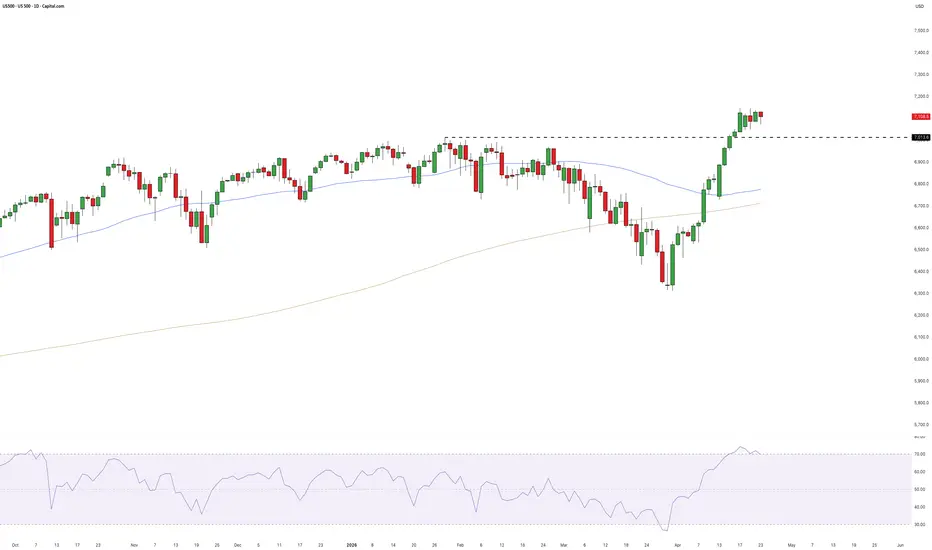
Looking at the current structure in the S&P 500, price is still behaving constructively. The market has pushed into new highs and, importantly, is holding above the breakout area. There hasn’t been a meaningful rejection or any shift in structure that would suggest sellers are gaining control.
That doesn’t mean the backdrop is clean. Far from it. Geopolitical tensions remain elevated, negotiations continue to stall, and energy markets are still feeding through into inflation expectations and rate sensitivity. But the key point for traders is how price is responding to that backdrop.
US500 Daily Candle Chart

Past performance is not a reliable indicator of future results
Even with fresh headlines around the extension of the ceasefire and the continued build-up in the region, the reaction in equities has been relatively contained. There’s been a slight softening, but no real deterioration in structure. If anything, it appears to reinforce the idea that dips are still being absorbed rather than extended.
That’s the nuance that matters. The market isn’t ignoring what’s happening, it’s simply not responding to it in a bearish way. Until that behaviour changes, the path of least resistance remains higher, whether that feels comfortable or not.
What needs to change before a short makes sense
If the aim is to trade a turn rather than guess one, the focus has to shift from opinion to observable behaviour. A strong market only becomes a short when there’s clear evidence that the underlying strength is starting to fade.
That evidence tends to show up through a combination of signals:
• A breakout that fails and closes back within its prior range
• A sequence of lower highs after a push to new highs
• Momentum divergence aligning with weakening price structure
Even then, it’s not just about spotting the shift, it’s about timing the entry. Rather than reacting to the first sign of weakness, it often pays to wait for a clear trigger. That might be a decisive pause or small consolidation following a failed move or a break below a trendline, with risk defined above the recent high and targets aligned with the next area of support. At that point, the structure itself defines the key reference levels on both sides.
The key is that none of this is anticipatory. It’s reactive. The market has to show its hand first.
Building a repeatable process
The real challenge with counter-trend trading isn’t spotting the idea, it’s having the discipline to wait for it to set up properly. Strong trends naturally create the urge to act early, particularly when the narrative feels compelling.
A more consistent approach is to treat strength as a filter rather than a signal. When the market is trending cleanly and holding above key areas, the default stance is to respect that strength. Only when the structure begins to shift, through failed moves and weakening momentum, does the focus turn to opportunities on the other side.
This creates a simple but effective framework:
• Recognise when the market is trending and avoid the temptation to fade it too early
• Wait for clear signs of structural change
• Act only once price confirms the shift
It’s not about catching the exact top. It’s about aligning with what the market is doing, not what it feels like it should be doing.
Disclaimer: This is for information and learning purposes only. The information provided does not constitute investment advice nor take into account the individual financial circumstances or objectives of any investor. Any information that may be provided relating to past performance is not a reliable indicator of future results or performance. Social media channels are not relevant for UK residents.
Spread bets and CFDs are complex instruments and come with a high risk of losing money rapidly due to leverage. 81.31% of retail investor accounts lose money when trading spread bets and CFDs with this provider. You should consider whether you understand how spread bets and CFDs work and whether you can afford to take the high risk of losing your money.
In practice, strong markets rarely reverse simply because they feel ‘detached from reality’. More often, they continue to trend, and it’s the traders trying to fade that strength too early who end up on the wrong side of the move.
The mistake most traders make
There’s a tendency to confuse discomfort with opportunity. When price is holding near highs while macro risks dominate the narrative, it can create the impression that the market is out of sync with reality. That belief often leads to premature short positioning without any real confirmation from price.
The issue is that markets don’t turn because they should. They turn when order flow shifts, and that shift needs to be visible in the price action. Until then, strength is not something to fight, it’s information. A breakout that holds, a trend that continues to print higher highs, and a market that absorbs negative headlines without breaking down all point to underlying demand rather than exhaustion.
This is where many traders get caught out. They lean on the narrative and anticipate a reversal, rather than waiting for the market to show signs of one. In doing so, they repeatedly step in front of a trend that hasn’t finished.
What the market is actually saying
Looking at the current structure in the S&P 500, price is still behaving constructively. The market has pushed into new highs and, importantly, is holding above the breakout area. There hasn’t been a meaningful rejection or any shift in structure that would suggest sellers are gaining control.
That doesn’t mean the backdrop is clean. Far from it. Geopolitical tensions remain elevated, negotiations continue to stall, and energy markets are still feeding through into inflation expectations and rate sensitivity. But the key point for traders is how price is responding to that backdrop.
US500 Daily Candle Chart
Past performance is not a reliable indicator of future results
Even with fresh headlines around the extension of the ceasefire and the continued build-up in the region, the reaction in equities has been relatively contained. There’s been a slight softening, but no real deterioration in structure. If anything, it appears to reinforce the idea that dips are still being absorbed rather than extended.
That’s the nuance that matters. The market isn’t ignoring what’s happening, it’s simply not responding to it in a bearish way. Until that behaviour changes, the path of least resistance remains higher, whether that feels comfortable or not.
What needs to change before a short makes sense
If the aim is to trade a turn rather than guess one, the focus has to shift from opinion to observable behaviour. A strong market only becomes a short when there’s clear evidence that the underlying strength is starting to fade.
That evidence tends to show up through a combination of signals:
• A breakout that fails and closes back within its prior range
• A sequence of lower highs after a push to new highs
• Momentum divergence aligning with weakening price structure
Even then, it’s not just about spotting the shift, it’s about timing the entry. Rather than reacting to the first sign of weakness, it often pays to wait for a clear trigger. That might be a decisive pause or small consolidation following a failed move or a break below a trendline, with risk defined above the recent high and targets aligned with the next area of support. At that point, the structure itself defines the key reference levels on both sides.
The key is that none of this is anticipatory. It’s reactive. The market has to show its hand first.
Building a repeatable process
The real challenge with counter-trend trading isn’t spotting the idea, it’s having the discipline to wait for it to set up properly. Strong trends naturally create the urge to act early, particularly when the narrative feels compelling.
A more consistent approach is to treat strength as a filter rather than a signal. When the market is trending cleanly and holding above key areas, the default stance is to respect that strength. Only when the structure begins to shift, through failed moves and weakening momentum, does the focus turn to opportunities on the other side.
This creates a simple but effective framework:
• Recognise when the market is trending and avoid the temptation to fade it too early
• Wait for clear signs of structural change
• Act only once price confirms the shift
It’s not about catching the exact top. It’s about aligning with what the market is doing, not what it feels like it should be doing.
Disclaimer: This is for information and learning purposes only. The information provided does not constitute investment advice nor take into account the individual financial circumstances or objectives of any investor. Any information that may be provided relating to past performance is not a reliable indicator of future results or performance. Social media channels are not relevant for UK residents.
Spread bets and CFDs are complex instruments and come with a high risk of losing money rapidly due to leverage. 81.31% of retail investor accounts lose money when trading spread bets and CFDs with this provider. You should consider whether you understand how spread bets and CFDs work and whether you can afford to take the high risk of losing your money.

Disclaimer
The information and publications are not meant to be, and do not constitute, financial, investment, trading, or other types of advice or recommendations supplied or endorsed by TradingView. Read more in the Terms of Use.
Disclaimer
The information and publications are not meant to be, and do not constitute, financial, investment, trading, or other types of advice or recommendations supplied or endorsed by TradingView. Read more in the Terms of Use.