Potentially Great Short OpportunityFact 1: We've been in a long rally for the past four weeks = at least a retracement is potentially due
Fact 2: Rally (allegedly - or at least according to media) triggered by Iran War Cease Fire bets
Fact 3: Rally continued even after signs of war escalations (supports Theory 1 below)
Fact 4: Relati
Key facts today
Invesco’s Asia fixed‑income head Norbert Ling says Indian debt outlook is constructive as inflation pressures ease and RBI steps to support the rupee. Invesco manages about $2.1 trillion.
Key stats
About Invesco QQQ Trust, Series 1
Home page
Inception date
Mar 10, 1999
Structure
Open-Ended Fund
Replication method
Physical
Dividend treatment
Distributes
Distribution tax treatment
Qualified dividends
Income tax type
Capital Gains
Max ST capital gains rate
39.60%
Max LT capital gains rate
20.00%
Primary advisor
Invesco Capital Management LLC
Distributor
Invesco Distributors, Inc.
Identifiers
3
ISIN US46090E1038
QQQ is one of the most established and actively traded ETFs in the world. Per the rules of its index, the fund only invests in nonfinancial stocks listed on NASDAQ, and effectively ignores other sectors too, causing it to skew massively away from a broad-based large-cap portfolio. QQQ has huge tech exposure, but it is not a 'tech fund' in the pure sense either. The fund's arcane weighting rules further distance it from anything close to plain vanilla large-cap or pure-play tech coverage. The ETF is much more concentrated in its top holdings and is more volatile than our vanilla large-cap benchmark. Still, the fund has huge name recognition for the underlying index, the NASDAQ-100. In all, QQQ delivers a quirky but wildly popular mash-up of large-cap growth exposure. The fund and index are rebalanced quarterly and reconstituted annually. Prior to December 22, 2025, the fund was one of just a few that had operated as a unit investment trust. Modernizing into the more commonly used open-end fund structure provides greater operational flexibility in terms of securities lending and reinvesting any income.
Related funds
Classification
What's in the fund
Exposure type
Electronic Technology
Technology Services
Retail Trade
Stock breakdown by region
Top 10 holdings
Weekly Bias — 20 AprilTrading a “headline-driven” market requires a shift from predictive analysis to a structural positioning framework
When the news cycle oscillates between “World War III” & “diplomatic breakthrough,” the goal isn’t to guess the next headline, but to trade the market’s reaction to it relative to im
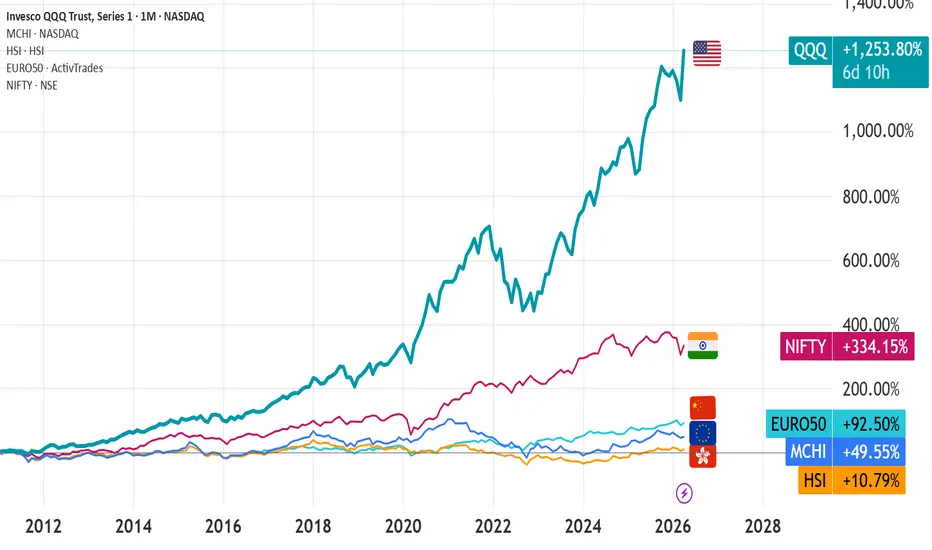
The most expensive chart you will see today 15 years. 5 major markets. One brutal truth.
NASDAQ:QQQ (US): +1,253% WOW
NSE:NIFTY (India): +334%
ACTIVTRADES:EURO50 (Europe): +92%
NASDAQ:MCHI (China): +49%
HSI:HSI (Hong Kong): +10%
If you invested $1,000 in US tech 15 years ago, you'd have ~$13,500 today.
That same $1,000 in Hon
Weekly Bias — 27 AprilThis week offers a perfect volatility cocktail
Mag7 earnings + FOMC + PCE + energy shock (Mid-East) = stacked event risk
This is exactly when IV lifts into the event → then compresses post-event
Market has been oscillating between positive gamma (pinning) & risk of gamma flip → trend accelerati
We now have bearish divergence on the monthyTo the 5 people who saw my QQQ prediction for this ATH, I thank you for your attention. We are now forming the top of the run that started in 2022. We now have bearish divergence on the monthly chart. I think we go mostly sideways from here, but when the next weekly cycle tops out in a few months, w
Embrace for Impact!* Check my first post on facts and theories ... I only had to adjust the levels following price action in the past three days
* Add another 2 theories: D Junior has liquidated his positions :), and de-risking before the weekend
* Second post mentions there's a short opportunity on the medium term ba
Nasdaq 100 ETF (QQQ) Nearing Completion of Wave 5 AdvanceThe Nasdaq‑100 ETF (QQQ) concluded its corrective phase against the cycle from the April 2025 low at $555.50. Since that point, the instrument has advanced in a clear five‑wave impulsive Elliott Wave structure, signaling renewed strength in the broader trend. From the March 31 low, wave 1 terminated
QQQ / NDX Weekly Outlook – Week 17 of 2026 (27-01 MAY)QQQ / NDX Weekly Outlook
Last Week’s Recap
Last week’s Long Scenario 1 played out extremely well on QQQ.
Price rejected slightly above the 642 level, and we entered with reduced size.
When zones work within very tight ranges, I use correlated assets as confirmation. If one of the correlated p
Lots of Possibilities. Be FlexiblePrice action yesterday made me abandon my original idea. We are in tricky zones (as often is the case!). I'm posting analysis on the hourly chart so weigh in your profit to risk factors very carefully and use your own technical analysis setups on smaller timeframes to make your entries/exits!
Yes
QQQ / NDX Weekly Outlook – Week 16 of 2026 (20-24 APR)QQQ / NDX Weekly Outlook
Last Week’s Recap
Long Scenario 1 played out exactly as expected. Once price broke above the Upper SD and secured acceptance, the market pushed higher and reached all time highs.
However, from an execution standpoint, we were waiting for a retest of the Upper SD to ent
See all ideas
Summarizing what the indicators are suggesting.
Oscillators
Neutral
SellBuy
Strong sellStrong buy
Strong sellSellNeutralBuyStrong buy
Oscillators
Neutral
SellBuy
Strong sellStrong buy
Strong sellSellNeutralBuyStrong buy
Summary
Neutral
SellBuy
Strong sellStrong buy
Strong sellSellNeutralBuyStrong buy
Summary
Neutral
SellBuy
Strong sellStrong buy
Strong sellSellNeutralBuyStrong buy
Summary
Neutral
SellBuy
Strong sellStrong buy
Strong sellSellNeutralBuyStrong buy
Moving Averages
Neutral
SellBuy
Strong sellStrong buy
Strong sellSellNeutralBuyStrong buy
Moving Averages
Neutral
SellBuy
Strong sellStrong buy
Strong sellSellNeutralBuyStrong buy
Displays a symbol's price movements over previous years to identify recurring trends.
Frequently asked questions
An exchange-traded fund (ETF) is a collection of assets (stocks, bonds, commodities, etc.) that track an underlying index and can be bought on an exchange like individual stocks.
QQQ trades at 664.23 USD today, its price has fallen −0.01% in the past 24 hours. Track more dynamics on QQQ price chart.
QQQ net asset value is 664.16 today — it's risen 13.01% over the past month. NAV represents the total value of the fund's assets less liabilities and serves as a gauge of the fund's performance.
QQQ assets under management is 427.02 B USD. AUM is an important metric as it reflects the fund's size and can serve as a gauge of how successful the fund is in attracting investors, which, in its turn, can influence decision-making.
QQQ price has risen by 16.30% over the last month, and its yearly performance shows a 42.24% increase. See more dynamics on QQQ price chart.
NAV returns, another gauge of an ETF dynamics, have risen by 13.01% over the last month, showed a 6.76% increase in three-month performance and has increased by 42.77% in a year.
QQQ fund flows account for 15.24 B USD (1 year). Many traders use this metric to get insight into investors' sentiment and evaluate whether it's time to buy or sell the fund.
Since ETFs work like an individual stock, they can be bought and sold on exchanges (e.g. NASDAQ, NYSE, EURONEXT). As it happens with stocks, you need to select a brokerage to access trading. Explore our list of available brokers to find the one to help execute your strategies. Don't forget to do your research before getting to trading. Explore ETFs metrics in our ETF screener to find a reliable opportunity.
QQQ invests in stocks. See more details in our Analysis section.
QQQ expense ratio is 0.18%. It's an important metric for helping traders understand the fund's operating costs relative to assets and how expensive it would be to hold the fund.
No, QQQ isn't leveraged, meaning it doesn't use borrowings or financial derivatives to magnify the performance of the underlying assets or index it follows.
In some ways, ETFs are safe investments, but in a broader sense, they're not safer than any other asset, so it's crucial to analyze a fund before investing. But if your research gives a vague answer, you can always refer to technical analysis.
Today, QQQ technical analysis shows the strong buy rating and its 1-week rating is buy. Since market conditions are prone to changes, it's worth looking a bit further into the future — according to the 1-month rating QQQ shows the strong buy signal. See more of QQQ technicals for a more comprehensive analysis.
Yes, QQQ pays dividends to its holders with the dividend yield of 0.42%.
QQQ trades at a premium (0.04%).
Premium/discount to NAV expresses the difference between the ETF’s price and its NAV value. A positive percentage indicates a premium, meaning the ETF trades at a higher price than the calculated NAV. Conversely, a negative percentage indicates a discount, suggesting the ETF trades at a lower price than NAV.
QQQ shares are issued by Invesco Ltd.
QQQ follows the NASDAQ 100 Index. ETFs usually track some benchmark seeking to replicate its performance and guide asset selection and objectives.
The fund started trading on Mar 10, 1999.
The fund's management style is passive, meaning it's aiming to replicate the performance of the underlying index by holding assets in the same proportions as the index. The goal is to match the index's returns.