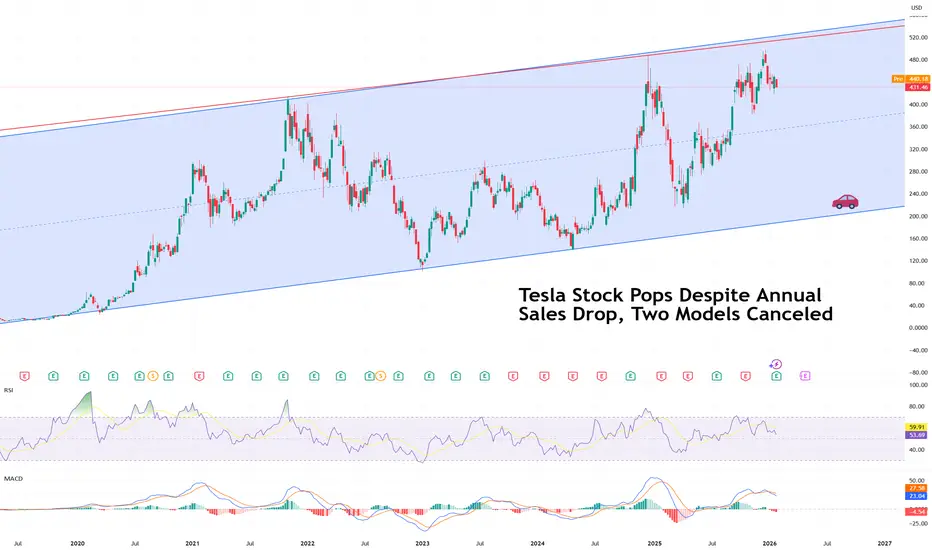
Tesla stock  TSLA managed a modest pop pre-market Thursday, rising about 3%, even as the company delivered a quarter that, on the surface, looked anything but celebratory.
Profits slid. Revenue dipped. Vehicle sales declined. Two iconic models were sent quietly into retirement. And yet, the stock bounced. Welcome to Tesla earnings season.
📉 Profits Fall, Reality Bites
Tesla reported a 61% drop in fourth-quarter profit, underscoring how much tougher the EV business has become. Revenue fell 3% in the quarter to $24.9 billion, bringing full-year 2025 revenue to $94.8 billion, also lower by 3% from the prior year.
EV sales dropped 16% year over year in Q4, and total vehicle deliveries for 2025 came in at 1.64 million, a 9% annual decline. That left Tesla trailing China’s BYD 1211 , which sold 2.26 million EVs last year and is now firmly wearing the global volume crown.
For a company that once defined EV dominance, this was a clear reminder that the market has caught up.
🏭 The End of an Era
Perhaps the most symbolic announcement came from Elon Musk himself. Tesla is ending production of the Model S and Model X, the premium vehicles that once represented the brand’s technological edge.
Sales have lagged behind Tesla’s mass-market models, and the economics no longer worked. “It’s time to basically bring the Model S and X programs to an end with an honorable discharge,” Musk said.
The Fremont factory space previously used for those vehicles will now be repurposed to manufacture Optimus humanoid robots, Musk said.
That decision alone tells you a lot about where Tesla believes its future lies. But also raises the question: New frontier or the perfect short entry?
🤖 From EV Maker to AI Builder
Tesla’s pivot toward artificial intelligence moved from abstract ambition to concrete capital this quarter. The company disclosed a $2 billion investment in xAI, Musk’s private AI startup, as part of its Series E funding round.
The move raised eyebrows, especially since Tesla shareholders had previously voted down a proposal to invest in xAI, with more “no” votes and abstentions than approvals. Tesla went ahead anyway.
SpaceX, which is eyeing a public listing in June, also committed $2 billion to xAI, reinforcing Musk’s push to build a vertically integrated AI ecosystem spanning cars, robots, rockets, and data.
Musk framed the effort as part of a broader mission. “There’s still obviously many who doubt our ambitions for creating amazing abundance,” he told investors, “but we’re confident it can be done.”
💸 Cash Flow Holds the Line
Despite the profit slump, Tesla delivered a small surprise where it mattered most to skeptics: cash flow.
Free cash flow came in at $1.4 billion, down 30% year over year but well ahead of analyst expectations, which had pointed to negative free cash flow. That cushion gives Tesla room to keep spending on AI and robotics without immediately stressing the balance sheet.
The company is clearly choosing to invest aggressively rather than defend margins, a decision that markets appear willing to tolerate, at least for now.
🚕 Cybercab Still on the Roadmap
Tesla also reiterated plans to begin production of Cybercab, its fully autonomous two-seater with no steering wheel or pedals, in April.
The vehicle remains one of the boldest expressions of Musk’s vision for an AI-first transportation future. It is also one of the least proven. Regulation, autonomy reliability, and consumer acceptance remain open questions.
Still, for investors inclined to think in decades rather than quarters, Cybercab represents optionality. For skeptics, it represents yet another promise waiting to be tested.
🌍 Competition Gets Real
Tesla’s challenges are no longer hypothetical. The EV market is crowded, price-sensitive, and increasingly competitive. Chinese manufacturers continue to scale aggressively. Government subsidies that once fueled demand are fading. Tesla’s lineup is aging faster than its innovation cycle can refresh it.
Musk’s strategy appears clear. EVs remain important, but they are no longer the center of gravity. AI, robotics, and autonomy now sit at the core of Tesla’s long-term story.
That pivot, however, comes with execution risk. Tesla still has to sell cars in the meantime, and margins remain under pressure.
🐻 The Bear Case Gets Louder
Not everyone is buying the vision. Veteran investor George Noble, former director at Fidelity International and founder of two hedge funds, has emerged as one of Tesla’s most vocal skeptics.
Speaking to Business Insider last week, Noble described Tesla as “possibly the biggest bubble in stock market history,” arguing that the stock is deeply disconnected from fundamental valuation.
What’s more, he believes shares should trade between $60 and $140, implying a potential drop of as much as 80% from recent levels.
In his view, Tesla remains primarily a car company with speculative upside attached, rather than an AI platform deserving of tech-multiple valuations.
📊 A Stock Caught Between Two Stories
That tension defines Tesla today. On the one side sits a slowing $1.4 trillion EV business facing global competition and margin compression. On the other stands an ambitious AI and robotics narrative that has yet to generate meaningful revenue.
The market’s reaction suggests investors remain willing to give Musk time, especially after they approved a hefty $1 trillion pay package. Tesla shares are still about 13% below their record high.
Peak earnings season continues with Apple AAPL reporting after market close today.
Off to you: Where do you land? Do you believe Tesla’s pivot toward AI and robotics marks the start of a new chapter, or do you think gravity eventually reasserts itself and pulls the stock back to earth?
TSLA managed a modest pop pre-market Thursday, rising about 3%, even as the company delivered a quarter that, on the surface, looked anything but celebratory.Profits slid. Revenue dipped. Vehicle sales declined. Two iconic models were sent quietly into retirement. And yet, the stock bounced. Welcome to Tesla earnings season.
📉 Profits Fall, Reality Bites
Tesla reported a 61% drop in fourth-quarter profit, underscoring how much tougher the EV business has become. Revenue fell 3% in the quarter to $24.9 billion, bringing full-year 2025 revenue to $94.8 billion, also lower by 3% from the prior year.
EV sales dropped 16% year over year in Q4, and total vehicle deliveries for 2025 came in at 1.64 million, a 9% annual decline. That left Tesla trailing China’s BYD
1211 , which sold 2.26 million EVs last year and is now firmly wearing the global volume crown.For a company that once defined EV dominance, this was a clear reminder that the market has caught up.
🏭 The End of an Era
Perhaps the most symbolic announcement came from Elon Musk himself. Tesla is ending production of the Model S and Model X, the premium vehicles that once represented the brand’s technological edge.
Sales have lagged behind Tesla’s mass-market models, and the economics no longer worked. “It’s time to basically bring the Model S and X programs to an end with an honorable discharge,” Musk said.
The Fremont factory space previously used for those vehicles will now be repurposed to manufacture Optimus humanoid robots, Musk said.
That decision alone tells you a lot about where Tesla believes its future lies. But also raises the question: New frontier or the perfect short entry?
🤖 From EV Maker to AI Builder
Tesla’s pivot toward artificial intelligence moved from abstract ambition to concrete capital this quarter. The company disclosed a $2 billion investment in xAI, Musk’s private AI startup, as part of its Series E funding round.
The move raised eyebrows, especially since Tesla shareholders had previously voted down a proposal to invest in xAI, with more “no” votes and abstentions than approvals. Tesla went ahead anyway.
SpaceX, which is eyeing a public listing in June, also committed $2 billion to xAI, reinforcing Musk’s push to build a vertically integrated AI ecosystem spanning cars, robots, rockets, and data.
Musk framed the effort as part of a broader mission. “There’s still obviously many who doubt our ambitions for creating amazing abundance,” he told investors, “but we’re confident it can be done.”
💸 Cash Flow Holds the Line
Despite the profit slump, Tesla delivered a small surprise where it mattered most to skeptics: cash flow.
Free cash flow came in at $1.4 billion, down 30% year over year but well ahead of analyst expectations, which had pointed to negative free cash flow. That cushion gives Tesla room to keep spending on AI and robotics without immediately stressing the balance sheet.
The company is clearly choosing to invest aggressively rather than defend margins, a decision that markets appear willing to tolerate, at least for now.
🚕 Cybercab Still on the Roadmap
Tesla also reiterated plans to begin production of Cybercab, its fully autonomous two-seater with no steering wheel or pedals, in April.
The vehicle remains one of the boldest expressions of Musk’s vision for an AI-first transportation future. It is also one of the least proven. Regulation, autonomy reliability, and consumer acceptance remain open questions.
Still, for investors inclined to think in decades rather than quarters, Cybercab represents optionality. For skeptics, it represents yet another promise waiting to be tested.
🌍 Competition Gets Real
Tesla’s challenges are no longer hypothetical. The EV market is crowded, price-sensitive, and increasingly competitive. Chinese manufacturers continue to scale aggressively. Government subsidies that once fueled demand are fading. Tesla’s lineup is aging faster than its innovation cycle can refresh it.
Musk’s strategy appears clear. EVs remain important, but they are no longer the center of gravity. AI, robotics, and autonomy now sit at the core of Tesla’s long-term story.
That pivot, however, comes with execution risk. Tesla still has to sell cars in the meantime, and margins remain under pressure.
🐻 The Bear Case Gets Louder
Not everyone is buying the vision. Veteran investor George Noble, former director at Fidelity International and founder of two hedge funds, has emerged as one of Tesla’s most vocal skeptics.
Speaking to Business Insider last week, Noble described Tesla as “possibly the biggest bubble in stock market history,” arguing that the stock is deeply disconnected from fundamental valuation.
What’s more, he believes shares should trade between $60 and $140, implying a potential drop of as much as 80% from recent levels.
In his view, Tesla remains primarily a car company with speculative upside attached, rather than an AI platform deserving of tech-multiple valuations.
📊 A Stock Caught Between Two Stories
That tension defines Tesla today. On the one side sits a slowing $1.4 trillion EV business facing global competition and margin compression. On the other stands an ambitious AI and robotics narrative that has yet to generate meaningful revenue.
The market’s reaction suggests investors remain willing to give Musk time, especially after they approved a hefty $1 trillion pay package. Tesla shares are still about 13% below their record high.
Peak earnings season continues with Apple
AAPL reporting after market close today.Off to you: Where do you land? Do you believe Tesla’s pivot toward AI and robotics marks the start of a new chapter, or do you think gravity eventually reasserts itself and pulls the stock back to earth?

Share TradingView with a friend:
tradingview.com/share-your-love/
Check out all #tradingviewtips
tradingview.com/ideas/tradingviewtips/?type=education
New Tools and Features:
tradingview.com/blog/en/
tradingview.com/share-your-love/
Check out all #tradingviewtips
tradingview.com/ideas/tradingviewtips/?type=education
New Tools and Features:
tradingview.com/blog/en/
Related publications
Disclaimer
The information and publications are not meant to be, and do not constitute, financial, investment, trading, or other types of advice or recommendations supplied or endorsed by TradingView. Read more in the Terms of Use.
Share TradingView with a friend:
tradingview.com/share-your-love/
Check out all #tradingviewtips
tradingview.com/ideas/tradingviewtips/?type=education
New Tools and Features:
tradingview.com/blog/en/
tradingview.com/share-your-love/
Check out all #tradingviewtips
tradingview.com/ideas/tradingviewtips/?type=education
New Tools and Features:
tradingview.com/blog/en/
Related publications
Disclaimer
The information and publications are not meant to be, and do not constitute, financial, investment, trading, or other types of advice or recommendations supplied or endorsed by TradingView. Read more in the Terms of Use.