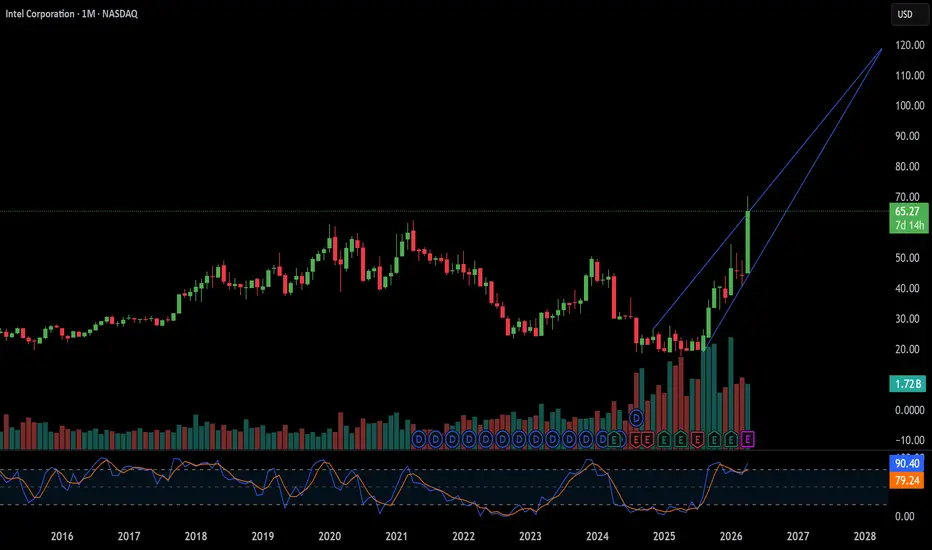
Intel Corporation – Breakout Above Multi-Decade ResistanceIntel just broke out of a resistance level it couldn't cross for 26 years.
Not a typo. 26 years.
Here is the full story. And it is a good one.
1/ August 2000.
Intel hit $75.81 per share.
The dot-com bubble burst. The stock crashed. And that $75.81 level became a wall that Intel could never climb back above.
For 26 years, every rally died at that line.
Until last week.
2/ What just happened?
Intel just reported Q1 2026 earnings. And they didn't just beat expectations.
They demolished them.
Revenue: $13.6 billion vs $12.4 billion expected
EPS: $0.29 vs $0.01 expected
That is not a beat. That is a reset.
3/ And the stock reacted accordingly.
Up 24% in a single day.
Intel's best single-day move since 1987.
The chart broke above 26 years of resistance on the same week as the earnings report.
That is not a coincidence.
4/ What is driving this?
Three things.
One. Google signed a multiyear deal to use Intel's Xeon processors for AI workloads across its cloud.
Two. Intel joined the Terafab project with Elon Musk, SpaceX, xAI, and Tesla. Musk confirmed Tesla will use Intel's next-generation chips.
Three. Data Center and AI revenue grew 22% year on year.
5/ There's a political angle too.
The Trump administration bought a 10% stake in Intel in August 2025 for $8.9 billion.
That position has now risen by 300%.
When the government owns a piece of the company, semiconductor policy and national interest align in Intel's favour.
6/ The numbers in context:
Stock up 24% on earnings day
Stock up more than 100% year to date
Stock up 4x over the past 12 months
Next quarter guidance: $13.8B to $14.8B
The analyst consensus was $13.1 billion. Intel guided above the top end of that.
7/ The big question now.
Can Intel hold this breakout?
The chart says yes if the 26-year resistance turns into support.
But the forward PE is at 117x. There is no room for disappointment.
Watch the Terafab timeline. Watch the Google Cloud ramp. Watch supply constraints.
The turnaround is real. The risk is real too.
Artificialintelligence
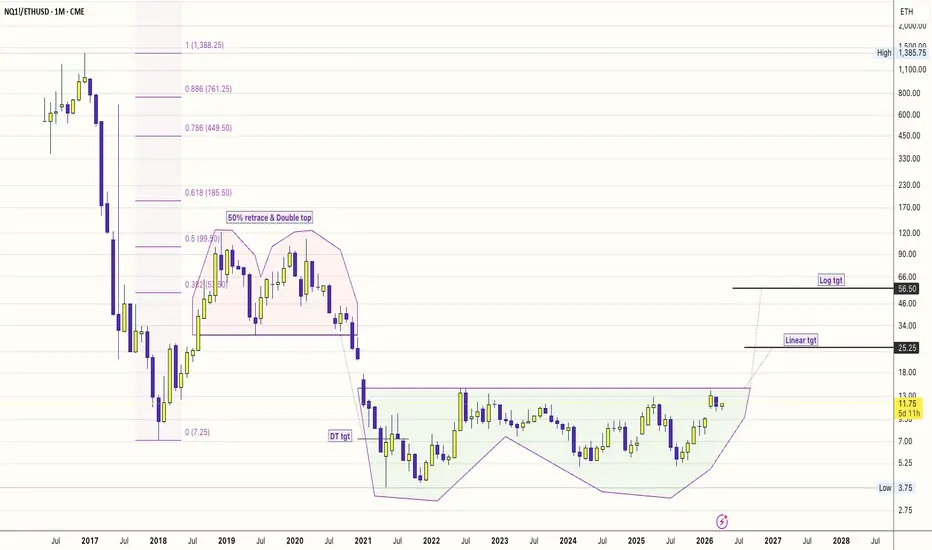
AI Infra > DeFi Infra: The 4-Year Relative Strength Breakout!1. The "Big Base" Logic
Observation: A 4-year base (2022–2026) in the NQ/ETH ratio.
This isn't just a price move; it’s a liquidity migration.
#DeFi (Ethereum) was the hero of the low-interest-rate era (2020-2021).
But in 2026, the "Real World" needs GPUs, data centers, and power grids.
The Nasdaq is the ticker for that physical reality.
The Trigger: Intel’s +24% move and Nvidia’s Blackwell dominance are the fundamental "fuel" for this technical breakout.
2. AI Infra (Hardware) vs. DeFi (Software)
The "Physical" Advantage: AI infra is now a $2.5 Trillion market.
It involves tangible assets (Chips, Fiber, Cooling).
The "Protocol" Fatigue: DeFi has become hyper-fragmented. There are too many L2s and protocols competing for the same liquidity. AI Infra, however, is a bottleneck economy—there is only so much compute to go around.
3. Key Levels
The Pivot: 13.00. A weekly close above this "Neckline" completes the 4-year U-Base.
The Targets: * Target 1 (25.25): The "Linear" target. This assumes Nasdaq continues to grow while ETH stays stagnant—a "repricing of utility."
Target 2 (56.50): The "Blue Sky" log target. This represents a world where AI agents become the primary users of the internet, making traditional human-centric DeFi secondary.
#NQ1! #ETHUSD
#NVDA, #INTC, #BTCUSD
#AIInfrastructure #RelativeStrength #DePIN #MacroEconomy #Semiconductors
In 2026, we’ve moved from "training" models to "running" them (Inference).
Running them requires constant, stable hardware—exactly what the Nasdaq companies are building.
$ETH vs $NVDA: The "World Compute" 0.886 Reality Check📉📉📉
The "World Computer" narrative is meeting the 0.886 Fibonacci reset.
While Ethereum ( CRYPTOCAP:ETH ) struggles to clear its $2k ceiling.
The actual compute leader powering 80% of #AI
( NASDAQ:NVDA ) has crushed it in relative price performance.
Ironic since Ethereum used to be mined on NVDIA GPU's !!!
The Setup: We are tracking a deep 0.886 retracement in the ETH/NVDA ratio, a level traditionally seen as the "capitulation zone" for underperforming assets.
Analysis: The AI explosion "real-world compute" has drained liquidity from speculative crypto layers.
Target: Watching for a structural bottom at the 0.886 reset level to see if the "World Computer" can finally find a bid against the hardware king.
Going forward... once achieved
ETH may only do well to simply retest the Double top neckline.
Intel: Mastering the Foundry and AI Chip RevolutionIntel stands at a pivotal crossroads in the semiconductor industry. The market recently pushed Intel's stock higher ahead of its critical earnings report. However, options pricing suggests a potential "sell the news" reaction. Investors are now weighing the company's massive structural shifts against short-term financial volatility.
Geostrategic Shift: The Foundry Gamble
Intel is aggressively reclaiming its manufacturing dominance. The U.S. Commerce Department actively supports Intel’s transition into a world-class foundry. Industry giants like Apple and NVIDIA may soon utilize Intel’s domestic facilities. This move secures Western supply chains against rising geopolitical tensions in the Pacific.
TSMC Acknowledges a Formidable Rival
The competitive landscape is shifting rapidly. TSMC leadership recently identified Intel Foundry as its most formidable competitor. This rare admission validates Intel’s "Five Nodes in Four Years" strategy. Rumors suggest Intel could manufacture Apple’s next-generation A20 SoC. Such a partnership would fundamentally alter global chip-making hierarchies.
AI Infrastructure and High-Tech Alliances
Intel is deepening its footprint in the artificial intelligence sector. The company recently joined Elon Musk’s Terafab project to build massive AI chip clusters. Furthermore, a new collaboration with Google aims to advance scalable AI infrastructure. These alliances ensure Intel remains central to the generative AI revolution.
Leadership and Cultural Renewal
The post-Gelsinger era focuses on disciplined execution and engineering excellence. Management is streamlining the business model to separate chip design from manufacturing. This transparency helps external customers trust Intel as a neutral foundry partner. The cultural shift prioritizes market agility over legacy bureaucratic structures.
Consumer Innovation: Core Series 3
Intel continues to defend its territory in client computing. The launch of Intel Core Series 3 processors targets everyday users. These chips integrate AI capabilities directly into the desktop and laptop experience. This innovation keeps Intel competitive against ARM-based rivals in the PC market.
Science and the Quantum Frontier
Intel is looking far beyond current silicon limitations. The company recently launched a silicon quantum processor collaboration with Argonne National Laboratory. This scientific venture targets scalable quantum computing for complex industrial problems. Patent analysis shows Intel is leading in silicon-based quantum dot technology.
Macroeconomics and Market Sentiment
Global macroeconomic factors continue to influence Intel’s recovery. High interest rates make capital-intensive fab construction more expensive. Nevertheless, the strategic importance of semiconductors ensures continued government subsidies. Intel must balance these long-term investments with immediate shareholder demands for profitability.
Cybersecurity and Digital Trust
Modern hardware must provide foundational security. Intel is embedding advanced cybersecurity features directly into its latest chip architectures. These hardware-level protections defend against sophisticated firmware attacks. Robust security remains a key selling point for Intel’s high-performance data center products.
Final Outlook for Investors
Intel is successfully transforming from a legacy chipmaker into a diversified tech titan. The foundry model offers a massive growth engine for the next decade. However, investors must tolerate short-term volatility as Intel spends heavily on future capacity. The company’s trajectory suggests a high-stakes bet on the future of American technology.
$VVV - Wave Analysis (5-10x)Logscale Daily chart - Fib levels are also Log Scale.
Speculation: We're in a smaller wave 5, within the larger Wave 3 cycle with upside target of $14.55
At that level we have an overlap of both the '1.618 trend-based fib extension' level extending from Waves 1 & 2, and the '2.618 fib projection level projecting from Wave 2.
Wave 4 correction likely to be shallow (0.382) compared to Wave 2 being a deeper correction (0.618). This would be around $6.40 from a previous high of $14.55 -- perhaps a midyear Q2 timeframe.
Wave 5 target is the 2.618 extension of Wave 1 & 2. It also correlates with the 2.618 fib extension of speculated wave 4 ($14.55 to $6.40).
TLDR:
Tar 1: Long $14.55
Tar 2: Short $6.40
Tar 3: Long $56+
Considerations:
I don't think wave 4 correction would be so deep, reason being is the actual buyback and deflationary fundamentals of VVV and upcoming reduction of its staking emissions by half. Also the DIEM utility with locking VVV supply to mint it for Agents to power their own operation is difficult to estimate impact on supply.
Adoption for Venice.ai from a native product side, scales into how many tokens of the circulating supply is burned -- there is a potential for a supply shortage of VVV as more is also being staked, burned, and emissions being cut while user adoption and revenue is growing fast. I have my doubts about seeing a retrace or correction to $6.40 from a push to $14.50. Maybe $10, the fundamentals around VVV make purely technical chart speculation less reliable. We shall see -- overall anything from here lower is still a buy for long term interests. $56 is a conservative target which would raise the Marketcap to approximately $2 Billion, up from $400m currently. All metrics show further growth and adoption so the market will follow.
ZETA AI Marketing Name Showing Real Momentum Right NowZeta Global NYSE:ZETA has been one of the names catching my eye lately and it’s finally showing some legs, up over 7% today and sitting around $17 with solid volume coming in.
Looking at the chart
just broke through a fresh Fair Value Gap around the $16 area.
There’s clear liquidity sitting higher near $19 that looks very reachable in the near term.
Below us there’s another liquidity pool around $14, but the momentum right now feels more likely to test the $19 zone first before any deeper retrace.
What really stands out for a medium to long-term setup
Athena by Zeta (their superintelligent AI marketing agent) just went live and already has strong early adoption, especially after the OpenAI partnership.
18 consecutive beat and-raise quarters and they just raised full year 2026 guidance significantly.
Institutional ownership is very high (85 %) and big money has been net buyers over the last couple of years
Analysts are mostly bullish with an average price target right around $29 roughly +65-70% from here, with some calling for even higher if AI execution continues.
Overall, ZETA feels like one of the cleaner AI plays in the marketing/tech space with real catalysts building into the end of 2026.
What do you think ?
Don’t forget to follow for more setups!
AI × DeFi and the Emergence of Agent-Driven ExecutionThe evolution of decentralized finance is increasingly defined by the transition from manual execution to autonomous agent-based systems. Rather than relying on user-initiated interactions, market participation is gradually shifting toward programmable agents capable of continuously monitoring conditions and executing predefined strategies across on-chain environments.
This shift is structurally important because it reduces the dependency on human reaction time and introduces a continuous execution layer operating above traditional DeFi protocols. In this framework, execution is no longer discrete but persistent, with systems dynamically adjusting exposure, liquidity, and routing decisions in response to real-time market data.
As adoption expands, the key differentiator is no longer access to information, but the efficiency and reliability of execution pipelines. This leads to a gradual compression of alpha windows, where speed, standardization, and system design become more important than directional insight alone.
Meta vs Microsoft – AI Euphoria or ExhaustionThe AI boom that lifted Big Tech to record highs may be entering its most delicate phase yet. Meta and Microsoft, two of the biggest winners of the AI wave, are now testing investors’ patience with a spending spree that’s starting to look excessive even by Silicon Valley standards.
In the last quarter alone, Meta, Microsoft, and Alphabet poured a combined $78 billion into data centers, GPUs, and AI infrastructure — an 89% increase year-over-year. The market’s reaction was telling: Meta and Microsoft both slipped after earnings, as traders began to question whether the growth in AI revenue can keep pace with the ballooning costs.
Microsoft’s $34.9 billion in capex didn’t deliver a higher growth rate for Azure, and Meta warned that next year’s spending will accelerate “significantly.” Google, by contrast, managed to calm investors with solid cloud growth and a more balanced tone — but even it now projects capex as high as $93 billion for 2025.
The common thread is clear: all three are betting the next decade on AI, but the near-term return on that investment remains murky. For Microsoft, capacity constraints still limit revenue growth. For Meta, the challenge is sharper — it’s spending on infrastructure without a clear monetization path, relying mostly on advertising optimization and early-stage hardware bets.
From a market perspective, both charts show fatigue setting in. After a year of relentless gains, momentum is flattening and volatility is creeping back in. The market still believes in AI — but it’s starting to question how much belief is already priced in.
If earnings growth doesn’t catch up with capex soon, these charts could be signaling the first cracks in the AI narrative. Whether this is just a pause or the beginning of a revaluation cycle will depend on how quickly these investments translate into tangible profit, not just GPU headlines.
Idea Summary:
NASDAQ:META and NASDAQ:MSFT are spending at record levels to stay ahead in AI, but returns are slowing. The charts hint at exhaustion — investors may be entering the first real “AI reality check.
Nebius (NBIS) — Pure-Play AI Compute With Hyperscaler ValidationNebius NASDAQ:NBIS is a full-stack AI infrastructure provider delivering GPU compute, AI cloud, and developer platforms across Europe and North America—positioned as a direct play on the global AI compute boom.
Key Catalysts
Meta deal = major validation + visibility: Nebius announced a new AI infrastructure agreement with Meta with a contract value up to ~$27B, including commitments tied to future cluster capacity—creating long-duration demand and funding momentum for its AI cloud buildout.
Post-Yandex focus is real: Following the Russia split and renaming, Nebius has repositioned into a focused AI infrastructure operator, scaling GPU clusters and data center footprint across regions.
Vertical integration via Toloka (compute + data + tools): Nebius and Toloka are actively integrating workflow layers (human reliability + agents + tooling) to strengthen the end-to-end AI stack.
Global cluster expansion: Nebius has been building and expanding GPU clusters (including in the U.S. and U.K.) to bring AI-native cloud capacity closer to customers.
Key Risks ⚠️
Execution + capital intensity, customer concentration (large hyperscaler deals), and heavy competition from AWS / Azure / Google and other GPU clouds. (Also watch GPU supply constraints and deployment timelines.)
Investment Outlook
Bullish above: $100–$105
Upside target: $200–$205
📌 NBIS is shaping up as a scaled, independent AI cloud builder—now “battle-tested” by hyperscaler-level demand.
CrowdStrike (CRWD): Nvidia Partnership & Long-Term OutlookI’ve been taking a closer look at CrowdStrike and overall, I’m coming away pretty bullish on the long-term story.
At a high level, this is a company that’s positioned right in the middle of some of the biggest trends right now—AI, cybersecurity, and cloud. I talked through how their platform works and why it’s becoming more essential as cyber threats get faster and more complex.
One of the more interesting recent developments is the news around Nvidia. To me, that’s a clear net positive. It shows CrowdStrike is leaning further into AI-driven security, which is exactly where the industry is headed. As more companies adopt AI tools and systems, the need to secure them only increases—and CrowdStrike looks well-positioned to benefit from that.
I also touched on some of the financials. Yes, stock-based compensation—around $1.1B—is something to keep an eye on, but at the same time, the core business still looks strong. Revenue continues to grow, especially on the subscription side, which is key because that recurring revenue creates stability and predictability over time.
From a bigger picture perspective, I think earnings per share has room to keep growing, supported by that recurring revenue model and expanding product ecosystem. This isn’t just a one-product company anymore—it’s becoming more of a full platform.
So overall, I see CrowdStrike as a company with a solid long-term runway. Strong positioning, growing demand, and exposure to major tech trends make it one I’m continuing to watch closely.
The information provided in this video is for informational purposes only and does not constitute investment advice, financial advice, or a recommendation to buy or sell any securities. Investing involves risk, including the potential loss of principal. Always conduct your own due diligence.
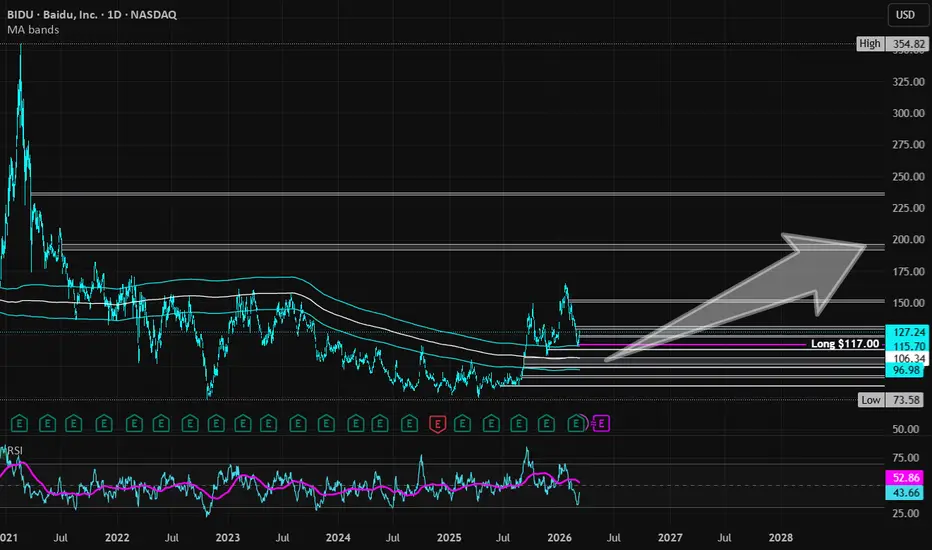
Baidu | BIDU | Long at $117.00Technical Analysis
The stock price for Baidu NASDAQ:BIDU recently dipped to the top channel of my selected historical simple moving average. This "regression-to-the-mean" area is an inevitable spot for the price to find support or resistance. While the lower end of the channel is around $96 and the mean is $106, it's a 50/50 call as to how this will move going forward given world tension and AI sentiment. These lower levels could absolutely be reached in the near-term. Personally, I think new longer-term highs (1-3 years) are ahead for this company based on fundamentals alone. But the elephant in the room is whether the political administration will threaten to remove Chinese companies from the US stock exchange if world tensions grow.
Fundamentals
Fair Value: $104
Current P/E: 76x (high, but...)
Forward P/E: 15x (major growth ahead)
Debt-to-Equity: 0.4 (low debt)
Free Cash Flow Yield: 2.9% (lower end and want to see >7%)
EPS Growth from 2026 ($8) to 2029 ($14): 75%
Revenue Growth from 2026 ($19.3 billion) to 2029 ($23.6 billion): 22.5%
Action
Fundamentals are good, growth is solid, and the "Chinese Google" will likely take off just like its US counterpart sometime in the future. However, there could be some near-term pain (even into the $80s) if US sentiment shifts negatively toward Chinese equities. It's a risk, but I plan to slowly build a position if the price drops into the bottom of my selected historical simple moving average or lower (especially in the last remaining price gap is closed in the $80s). Thus, at $117, NASDAQ:BIDU is in a personal buy zone (starter position) with further entries planned if the price falls (unless delisting is announced).
Targets into 2029
$150.00 (+28.2%)
$190.00 (+62.4%)
Defensive Alpha: Why Gold is Outperforming the Software SectorThe chart doesn't lie: capital is moving from the 'frothy' software multiples of the last two years. By charting Gold against the IGV (Software ETF), we see a clear breakout from a multi-year inverse head and shoulders bottom.
Which only just broke out in January!
This suggests that even if Tech bounces, the real 'Alpha' for much of the rest of the year may reside in metals as institutions seek shelter from AI-valuation resets.
$MSFT: Hidden Bullish Divergence at Key $400 SupportMicrosoft is indeed in a fascinating spot.
While the price has retreated from its late-2025 highs (around $540-$550), the long-term structural integrity remains intact.
What the Chart is Telling Us:
A hidden bullish divergence occurs during a pullback in an existing uptrend.
The Higher Low: Despite the "SaaSpocalypse" volatility earlier this year and concerns over AI CapEx, NASDAQ:MSFT could potentially form a base around the $395 - $400 psychological support zone.
The "selling momentum" looks intense on the indicator, the actual price isn't falling as far as the momentum would suggest. It’s often a sign that the bears are exhausted and the primary uptrend is ready to resume.
NASDAQ:MSFT is navigating some "heavy" overhead supply.
$400 Psychological SupportThe "line in the sand" where buyers have recently stepped in.
$427 - $433 Immediate Resistance Convergence of the 20-day SMA and the 200-day SMA.
A break above here confirms the reversal.
$462Key Resistance The 50-day SMA; clearing this would likely signal a run back toward the $500 mark.
Note: Many institutional analysts (like Morgan Stanley) still hold price targets in the $600+ range for 2026, viewing this current technical "washout" as a deep-value opportunity despite the recent downtrend.
****Not financial advice****
Especially when the trend has been so strong to downside.
(Which I did suggest could happen after the double top trigger.)
Reversal trading has blown up many retail accounts.
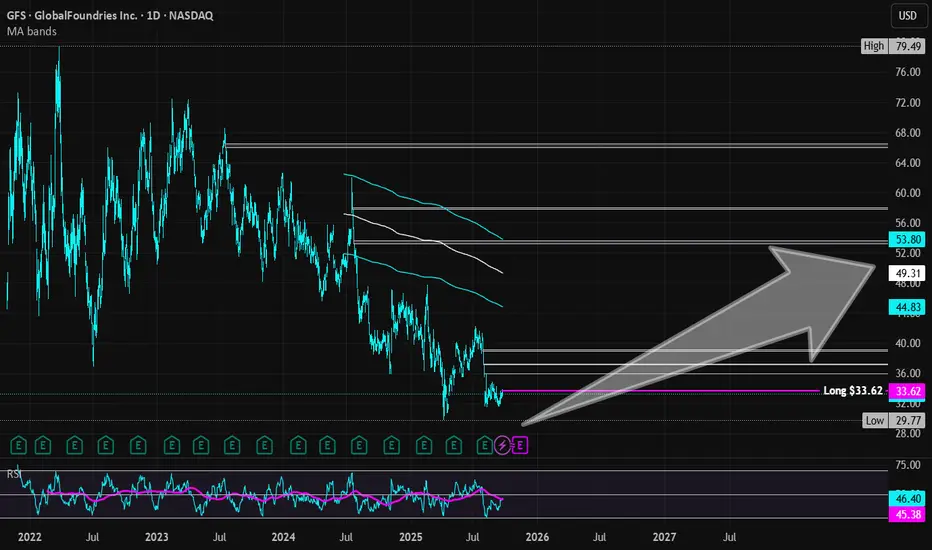
GlobalFoundaries | GFS | Long $33.62GlobalFoundaries NASDAQ:GFS
Technical Analysis:
The price is currently trading below the historical mean (see lines on chart). Given the "newness" of this stock on the market (IPO in 2021), I would often avoid an entry here until more data are gathered to better understand if the downside trend is reversing. However, in an era where AI integration is the future of tech, the growth prospects of NASDAQ:GFS make it undervalued in the semiconductor space. The current fair value is near $20. The price may get there in the near-term. But sometimes future fundamentals outweigh technical analysis... sometimes... Time will tell.
Earnings and Revenue Growth
Forecasted revenue growth between 2025 ($6.75 billion) and 2028 ($8.88 billion): 31.6%
Forecasted earnings-per-share growth between 2025 ($1.62) and 2028 ($3.12): 92.6%
www.tradingview.com
Health
Debt-to-Equity: 0.15x (low, healthy)
Altman's Z-Score/Bankruptcy Risk: 2.48 (low risk)
Insiders
Silent...
openinsider.com
Action
Due to the growth prospects and likely high demand of semiconductors, NASDAQ:GFS is in a personal buy zone at $33.62. This entry goes against some technical analysis guidance (more downside may be inevitable this year), but the *long-term* upside is more than likely there *if* earnings and revenue growth projections are accurate beyond 2025.
Targets in 2028
$39.00 (+16.0%)
$50.00 (+48.7%)
Review and plan for 13th February 2026 Nifty future and banknifty future analysis and intraday plan.
Quarterly results.
This video is for information/education purpose only. you are 100% responsible for any actions you take by reading/viewing this post.
please consult your financial advisor before taking any action.
----Vinaykumar hiremath, CMT
AI Sector Amid 2026 VolatilityReport: Technical Analysis on AI Sector Amid 2026 Volatility
In early 2026, the AI sector exhibits heightened volatility, with major stocks like NVIDIA (NVDA) showing strong rebounds amid broader market concerns over AI investment returns.
NASDAQ:NVDA closed at $185.41 on February 6, up 7.92% that day, reflecting optimism from earnings forecasts and AI advancements, though the sector faces pressures from software disruptions and overvaluation fears. 📈
Key trends include a shift away from the Magnificent Seven toward emerging players like Meta Platforms and Shopify, with AI-driven capex expected to drive growth but also contributing to market swings. Opportunities lie in undervalued stocks like Seagate Technology (up 332% over the past year), while risks include potential AI bubble bursts and displacement of traditional software firms. 💡⚠️
This report analyzes technical indicators, interconnections with tech subsectors, and recommendations for retail investors, emphasizing balanced portfolios in this dynamic landscape.
Overall, the sector holds promise for long-term gains if innovation translates to revenue, but short-term caution is advised.
Market Overview and Interconnections
The AI sector in February 2026 is navigating a turbulent phase, marked by significant sell-offs followed by partial recoveries.
Broader market trends show tech indices rebounding from early-year slumps, driven by positive economic indicators like manufacturing expansions. However, AI stocks have underperformed compared to 2025 highs, with the WisdomTree Cloud Computing Fund down 20% year-to-date due to fears that generative AI could disrupt software business models.
This has led to a $400 billion market wipeout in software-related valuations, as investors reassess companies vulnerable to AI agents replacing human-driven tasks.
Interconnections extend to related sectors such as cloud computing, big data, and semiconductors. For instance, AI's growth fuels demand for data storage, benefiting firms like Seagate Technology (STX), which has surged 332% over the past year. Meanwhile, e-commerce platforms like Shopify integrate AI for enhanced search and user experiences, posting 18.6% annual revenue growth.
These ties highlight how AI permeates beyond pure-play stocks, influencing biotech (via drug discovery) and green energy (through optimized grids). Volatility is the overarching theme, with leadership shifting from mega-caps like NVIDIA to mid-tier innovators. Investors should monitor cross-asset links, such as AI's energy demands boosting commodities like copper for data centers.
Data and Stats
Key AI stocks display mixed technical signals. NVIDIA (NVDA), a bellwether, trades at $185.41 with a market cap of $4.514 trillion and a 52-week range of $86.62 to $212.19. Its forward P/E of around 23 suggests relative value amid growth projections. Meta Platforms (META) is highlighted as a top pick for 2026, trading at 23x forward earnings, with AI revenue opportunities emerging from new models in social media and advertising.
• Top Performers Table:
| Stock | 1-Year Return | Forward P/E | Market Cap | Key Driver |
|-------|---------------|-------------|------------|------------|
| Seagate (STX) | 332.30% | 46.20 | Not specified | AI data storage demand |
| Meta (META) | Strong rebound | 23 | Large-cap | AI in apps and ads |
| Shopify (SHOP) | Positive growth | High | Mid-cap | AI-enhanced e-commerce |
| HubSpot (HUBS) | Down 39% YTD | Elevated | Mid-cap | Software AI integration |
| NVIDIA (NVDA) | Volatile | 23 est. | $4.514T | AI hardware dominance |
Technical charts indicate overbought conditions in some areas. For NVDA, assuming standard indicators (as chart data is limited), the RSI likely hovers near 60-70 post-rebound, signaling momentum but potential pullback if it exceeds 70. MACD crossovers may show bullish divergence, with the 50-day MA around $170 supporting upside, while the 200-day MA at $140 provides long-term floor. Sector-wide, the Nasdaq Composite's 2.5% weekly loss underscores caution, with AI investments scrutinized for profitability.
Fundamental ties bolster TA: AI capex is projected to remain strong, particularly in infrastructure, potentially lifting stocks like Palantir and Amazon ahead of earnings. SWOT analysis reveals strengths in innovation (e.g., Meta's AI models for weather forecasting), weaknesses in high valuations, opportunities in adoption acceleration, and threats from regulatory scrutiny or economic slowdowns.
Opportunities and Recommendations
💡 Opportunities abound in undervalued AI plays. Consider buying dips in Meta for its dirt-cheap valuation and upcoming product ships. Diversify into high-growth names like Zscaler (45.93% earnings growth) for cybersecurity AI. Options strategies: Bullish calls on NVDA targeting $200 strike for March expiration, hedging with puts amid volatility. For dividend seekers, pair with stable tech like Microsoft, which ties AI to cloud services.
Expand to sectors: AI's role in EVs (e.g., autonomous driving) links to autos, suggesting bundled positions in Tesla alongside NVDA. Staking in crypto like Ethereum, enhanced by AI oracles, offers yield alternatives.
Risks
⚠️ Risks include further software slumps, with HubSpot down 39% YTD as AI agents threaten models. Bubble fears persist, with some predicting rough rides if AI spending doesn't yield profits. Geopolitical tensions could spike energy costs, indirectly hitting AI data centers. Monitor VIX above 18 for broader market stress.
Conclusion
The AI sector in 2026 presents a compelling yet volatile landscape, with technical rebounds in stocks like NVDA signaling potential upside amid shifting leadership. By integrating TA with fundamentals, investors can capitalize on opportunities in emerging players while mitigating risks through diversification. Focus on innovation-driven growth, but remain vigilant for profitability proofs. This analysis underscores the sector's interconnections, offering actionable insights for balanced portfolios.
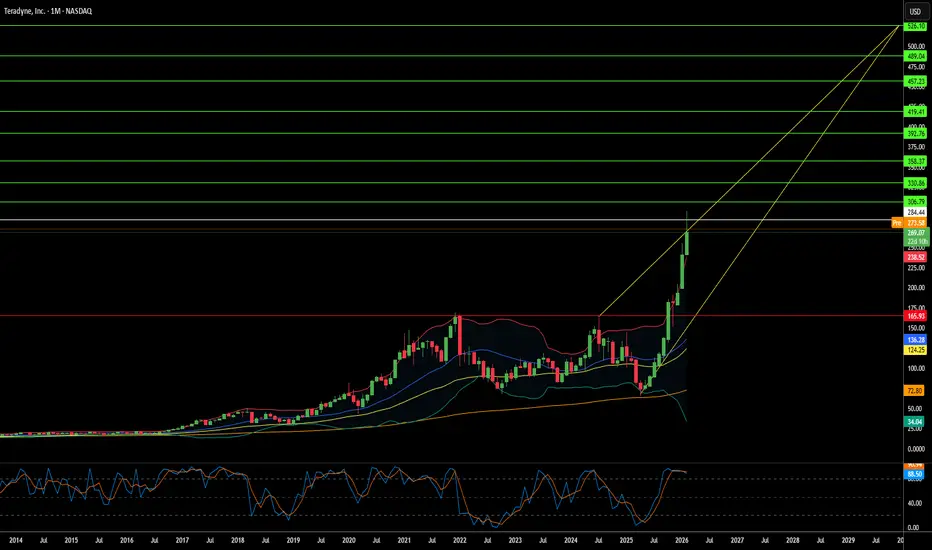
Can a Testing Company Become AI's Hidden Infrastructure?Teradyne has executed one of the semiconductor industry's most dramatic strategic pivots, transforming from a mobile-centric testing company into a dominant force in AI infrastructure validation. With artificial intelligence now driving over 60% of total revenue as of late 2025, the company has positioned itself at the critical junction where cutting-edge chips meet real-world deployment. Management's newly introduced "evergreen" earnings model targets $6 billion in annual revenue and non-GAAP earnings per share between $9.50 and $11.00, reflecting not just incremental growth but a fundamental business model transformation. The Q4 2025 results underscore this shift: record-breaking revenue of $1.083 billion, 41% sequential growth, and 44% year-over-year expansion driven almost entirely by AI tester demand.
The company's technical moat extends far beyond traditional automated test equipment. Teradyne's UltraPHY 224G solution addresses emerging 224 Gb/s data rates critical for next-generation AI clusters, while the Magnum 7H tester targets the upcoming HBM4 memory cycle—a market where testing intensity is 10x that of standard DRAM. The newly formed joint venture with MultiLane positions Teradyne to capture the high-speed interconnect testing market from wafer to data center, moving the company closer to hyperscale infrastructure budgets. Meanwhile, the robotics division is pivoting toward "Physical AI," integrating deep learning models into collaborative robots that adapt to dynamic environments rather than following rigid pre-programmed paths. A strategic Detroit manufacturing hub will support threefold expansion with major e-commerce customers in 2026.
Geopolitical headwinds remain manageable but require vigilant navigation. While China historically represented 25-30% of revenue, the Trump administration's shift from "presumption of denial" to "case-by-case" reviews for advanced computing exports provides regulatory flexibility. However, 25% tariffs on advanced semiconductor components passing through U.S. facilities complicate global supply chains. Teradyne's formidable patent portfolio, comprising over 5,000 patents across 30 jurisdictions, serves as both legal armor and a technological deterrent. The strategic use of Track One rapid examination and Non-Publication Requests helps maintain a competitive advantage. The partnership with TSMC, recognized through the 2025 OIP Partner of the Year award, reinforces leadership in chiplet and 3D stacking methodologies essential for HBM4 and UCIe architectures.
The investment thesis centers on structural market positioning rather than cyclical momentum. Teradyne commands 50% market share in "XPU" testing and targets 30% in GPU testing as merchant GPU customers scale production. While customer concentration (particularly Apple ecosystem exposure), institutional selling pressure, and the inherent "lumpiness" of AI infrastructure spending present near-term risks, management's Q1 2026 guidance of $1.15-$1.25 billion revenue signals a sustained trajectory. The convergence of silicon photonics, HBM4 memory walls, and Physical AI robotics creates multiple expansion vectors. For investors willing to accept premium valuation multiples, Teradyne represents not merely a beneficiary of AI spending but an essential architectural layer enabling the transition from research to production-scale deployment.
Google’s AI Pivot: The World’s Next Pharma GiantAlphabet recently shattered Wall Street expectations with its Q4 2025 earnings report. Management is aggressively increasing capital expenditure for 2026. This spending fuels a massive expansion of AI infrastructure. Investors now see a clear shift in Google's corporate strategy.
The Great Technological Pivot
Google is no longer just a search engine company. It is transforming into a dominant scientific powerhouse. DeepMind remains the crown jewel of this technological ecosystem. Their newest AI models now learn faster than any previous systems.
From AlphaFold to AlphaGenome
AlphaFold already solved the protein-folding mystery for global science. Now, AlphaGenome decodes the "dark matter" of the human genome. It processes a million DNA letters at once. This tool predicts gene regulation with unprecedented precision.
The Most Important Pharma Company
This technology transforms Google into a pharmaceutical powerhouse. Traditional drug discovery is notoriously slow and expensive. Google’s AI accelerates this process by several decades. They now own the digital blueprint of human biology.
Patent Analysis and High-Tech Moats
Google’s patent portfolio reveals a deep focus on biotechnology. They dominate the foundational algorithms for life sciences. This intellectual property creates an unassailable competitive advantage. No traditional pharmaceutical company can match this computational scale.
Geostrategy and Leadership
CEO Sundar Pichai is leading an "AI-first" biological revolution. This geostrategy secures Google's role in global health security. Management is prioritizing long-term scientific dominance over advertising growth. They are building a more resilient, high-tech business model.
Macroeconomics and Cybersecurity
Macroeconomic pressures do not hinder their scientific progress. Google secures sensitive genetic data with advanced cybersecurity. This trust remains vital for the future of medicine. Alphabet is becoming the ultimate architect of human longevity.
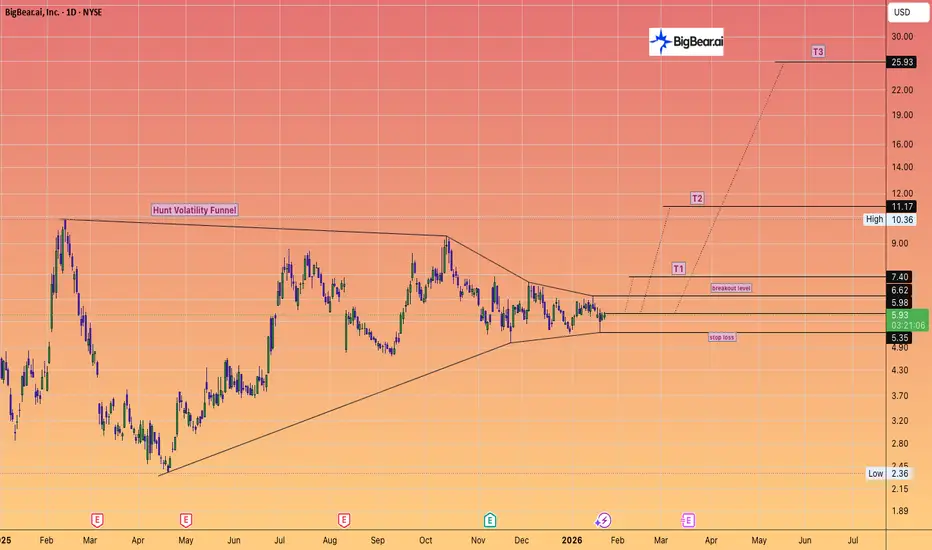
$BBAI: From Hibernation to 4X AI rocket ship?🐻🐻🐻
BigBear.ai is no longer just a struggling SPAC; it is positioning itself as the "Palantir for the Rest of Us" in the defense and cargo security sectors.
(at least that is the narrative)
I'm looking at a 4X potential move on #BBAI as it coils at the bottom of a massive #HVF pattern
@TheCryptoSniper
The Move: A high-volume break of $6.62 targets the previous highs near $10.36, with an ultimate 'cycle' target in the mid $20s.
The Fuel: Debt is gone, and the company is now a 'Smart Trade' powerhouse after the CargoSeer and Ask Sage acquisitions.
Don't sleep on the only sub-$3B AI play with deep U.S. Army and Middle East government ties. If this 'coiling' breaks up, it could make some peoples' entire year."
#BBAI #BigBearAI #AIStocks #SmallCap #Breakout #TechnicalAnalysis
Is Salesforce Now a Defense Contractor?Salesforce has reached a defining inflection point that fundamentally transforms its corporate identity. The company, historically known as a commercial software provider, has secured a massive $5.64 billion contract with the U.S. Army extending through 2035. For the first time, the tech giant is positioning itself as a "defense prime contractor" and embracing the Trump administration's provocative rebranding of the Department of Defense as the "Department of War." This move not only stabilizes the company's revenue stream with a long-term, firm-fixed-price agreement but also places it at the center of U.S.-China geopolitical competition and brings it closer to the traditional defense industrial base.
The market has responded with enthusiasm - analysts have raised price targets above $320 per share, and investors view the contract as a bond-like guarantee of stable cash flow. The company's stock surged to the $257 range in early 2026, reflecting Wall Street's revaluation of Salesforce as critical national infrastructure rather than as a volatile SaaS business. However, the pivot carries significant risks. It jeopardizes Salesforce's operations in China, where it has operated for years through local partnerships, and raises serious questions about data sovereignty in Europe, particularly given the U.S. CLOUD Act. With 20% of revenues coming from Europe, Salesforce is entering direct conflict with the digital sovereignty demands of leaders like Macron and Scholz.
The technological dimension is equally compelling: Salesforce is aggressively investing in Agentforce, its autonomous AI agent platform, competing directly with Palantir for dominance in the government software market. The technology promises radical automation of military logistics and personnel management, leveraging Salesforce's enormous advantage in commercial customer data across millions of users. CEO Marc Benioff has emphasized their pricing advantage, undercutting competitors by amortizing R&D costs across their massive commercial base. Yet questions remain: can this pivot deliver long-term returns, or will the company find itself caught in trade wars, sanctions, and regulatory restrictions that undermine future profitability? The transformation from SaaS giant to defense contractor represents either a brilliant strategic repositioning or a dangerous entanglement with geopolitical risk.
Can Yellow Iron Become Digital Gold?Caterpillar Inc. stands at a historic inflection point in 2026, simultaneously threatened by geopolitical chaos and empowered by artificial intelligence. The company faces a $1.75 billion tariff hit stemming from U.S.-EU trade warfare over Greenland's rare earth elements, directly compressing operating margins and forcing supply chain bifurcation. Yet this same Arctic conflict positions Caterpillar as the default infrastructure provider for Western mining operations in one of the world's harshest environments, where its cold-weather engineering expertise and autonomous Cat Command systems create an unassailable competitive moat.
The strategic metamorphosis from commodity-cycle dependent machinery maker to "Physical AI" provider represents management's most ambitious pivot. Through deep integration with NVIDIA's Jetson Thor platform, Luminar's LiDAR technology, and the Helios digital backbone aggregating data from 1.4 million connected assets, Caterpillar is embedding intelligence at the edge of industrial operations. The company's patent portfolio reveals aggressive R&D in autonomous excavation and hydrogen fuel cell optimization, while the appointment of electrification expert Rod Shurman to lead Construction Industries signals that the energy transition has moved from experiment to core strategy. The 793 XE battery-electric mining truck at BHP's Australian operations demonstrates technical viability, though the hydrogen stationary power success at Microsoft data centers may prove more immediately scalable.
The market struggles to reconcile Caterpillar's 32x earnings multiple with traditional cyclical machinery valuations, yet secular tailwinds from data center construction and global mining capex cycles support a technology-industrial premium. The North American infrastructure boom and AI-driven power generation demand offset weakness in European manufacturing and the Chinese real estate collapse. While cyber-physical vulnerabilities and the Bobcat patent litigation present meaningful risks, the company's transformation from a horsepower vendor to a computing power provider appears irreversible. For long-term investors, the volatility from Arctic trade disputes will create superior entry points around $580, making Caterpillar an accumulation opportunity in the digitization of the physical industry.